If you’re looking for the most efficient, quietest and most flexible source of backup electrical power for your home, then large inverter-generators are something you should know about. This is one place where generator technology is improving quickly and it offers capabilities we haven’t seen before.
Inverter-generators are engine-driven, fuel-burning sources of off-grid electricity, but they’re different from conventional portable generators in three important ways. They burn less fuel, they make less noise, and the electricity they produce is of higher quality. The world has had inverter-generators for a while, but when they first came out they were too small and too simple to serve as household backup protection. This post will explain how this has changed, but to understand why, you need to know something about household electrical systems across North America.
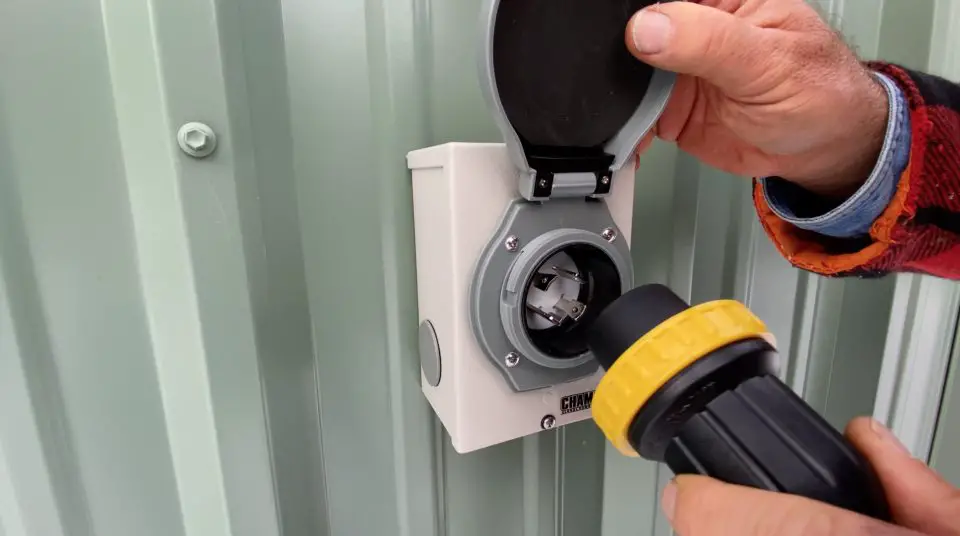
All homes in our part of the world have two different voltages delivered via household wiring systems. There’s 120 volts at outlets and lights, and 240 volts for larger items such as stoves, dryers, electric water heaters and most water well pumps. When inverter generators first came out they were not only too small to handle household electrical demands, but they also only put out 120 volts, so weren’t suitable for whole-house backup, even apart from the lack of capacity. With the advent of large, dual voltage 120 volt/240 volt portable inverters, however, entire homes can now be powered with a single cable delivering power to an outdoor port. That’s one below.
You’ll burn less fuel and create less noise than with a regular generator, but you also have the possibility of portable power away from your home for building work, camping or any other use out of reach of the grid. That’s something that stationary standby generators – one of several whole-house backup options – can’t do.
I live on an island in rural Ontario, and our power comes from a single incoming high voltage transmission line traveling across miles of rough landscape. This is one reason we get more power failures than other places, but it also means I have plenty of opportunity to test off-grid power options. This is what I’ve been doing lately.
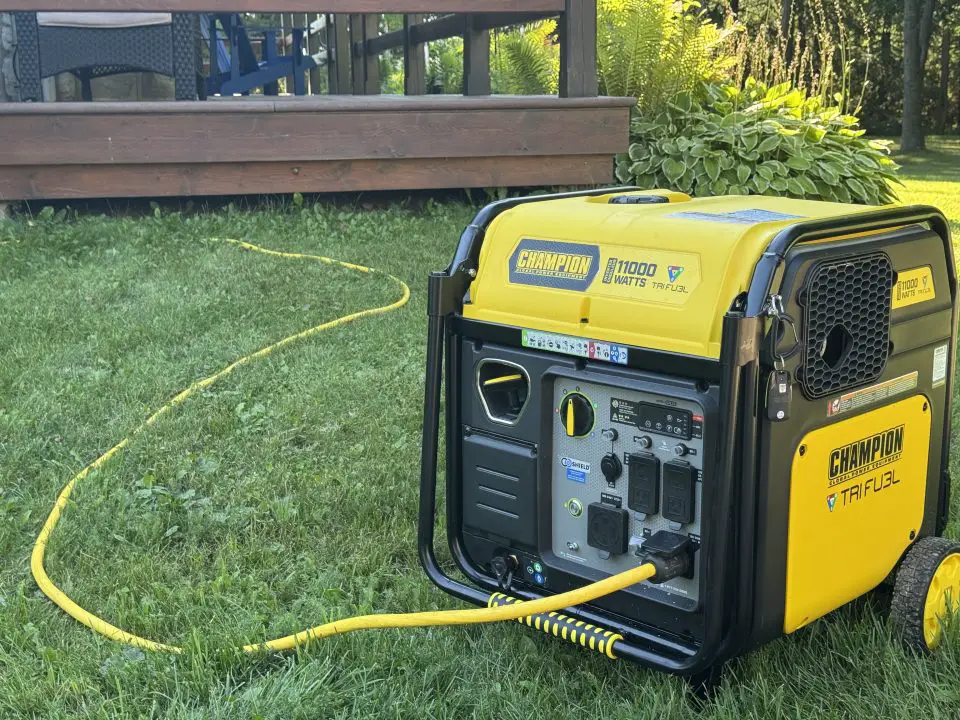
Over the last year I’ve used a Champion 11,000 watt model#201424 for household backup during three outages lasting 12+ hours each. The unit has performed flawlessly, and rivals the power output offered by stationary home standby generators, but in a portable package. Besides power output, there’s something else you need to know.
I’ve been testing and writing about generators for 30+ years, and I’m impressed with the way Champion has grown the refinement and affordability of their products. When I first saw the Champion brand it was a basic, low-cost option, but the “basic” part of this has changed over the last 15 years. While still maintaining surprisingly low prices, the level of refinement and features has increased to the point where Champion has actually eclipsed Honda in my opinion – the gold standard of portable generators. Here’s a look at the numbers . . .
I own a Honda 7000 watt inverter (5500 watts continuous output) and it’s been a great machine ever since I bought it. This is the largest inverter Honda offers and it currently costs $5328 in Canada the last time I checked. The 11,000 watt tri-fuel Champion (9000 watts continuous output) costs $3327. That’s 37 cents per watt of output compared with 97 cents per watt for the Honda. The Champion also has remote wireless starting capabilities, and it can burn gasoline, propane or natural gas interchangeably. This last fuel is especially attractive because it costs much less than the others, and where it’s available you can plumb the generator into your household natural gas supply for continuous operation with no need to fetch fuel from the gas station. To be fair, the Champion is very slightly louder and heavier than the Honda on paper, but these are small tradeoffs in my book and not something I even noticed until I looked up the specs.
If you value efficiency, quiet operation, portability and whole-house backup power protection, today’s big inverter generators are a pretty attractive option.




I hope you found this content useful!
Your generous support helps me produce more practical, hands-on content that I hope you’ll find useful.
Steve Maxwell