Stacking firewood in round piles can look unusual at first, but it’s one of the most practical ways I’ve found to store wood outdoors. After more than 25 years of stacking firewood in straight rows, I switched to round piles and haven’t gone back. Some version of this is practiced in Scandinavia, but the method I’ll show you here is my own approach. Video below.

The advantages are simple: round firewood piles go up faster, stay more stable, look better, use space efficiently and dry wood very well. Only the outside wall of the pile needs careful stacking. The centre can be filled with loose pieces, which makes the whole job quicker and easier. Here at my place we split wood into a tractor bucket, then drive over and dump the load in the round pile walls we’ve built up a bit ahead of time.
Key Takeaways
- Stacking firewood in round piles can be faster than building straight rows.
- Only the outside wall of a round wood pile needs careful stacking.
- Irregular or awkward pieces can be tossed into the middle.
- Round piles have a wide footprint, which helps make them stable.
- Long cross pieces placed through the pile help tie the structure together.
- Round firewood piles can shed rain well when covered properly.
- A tarp placed under the top layer of wood can act like a simple roof.
- Round piles can hold a surprising amount of wood in a compact space.
- A 10-foot diameter round pile can hold roughly 8 face cords if built high enough.
- Round wood piles look good and can make a firewood supply feel orderly and attractive.
Why Stack Firewood in Round Piles?
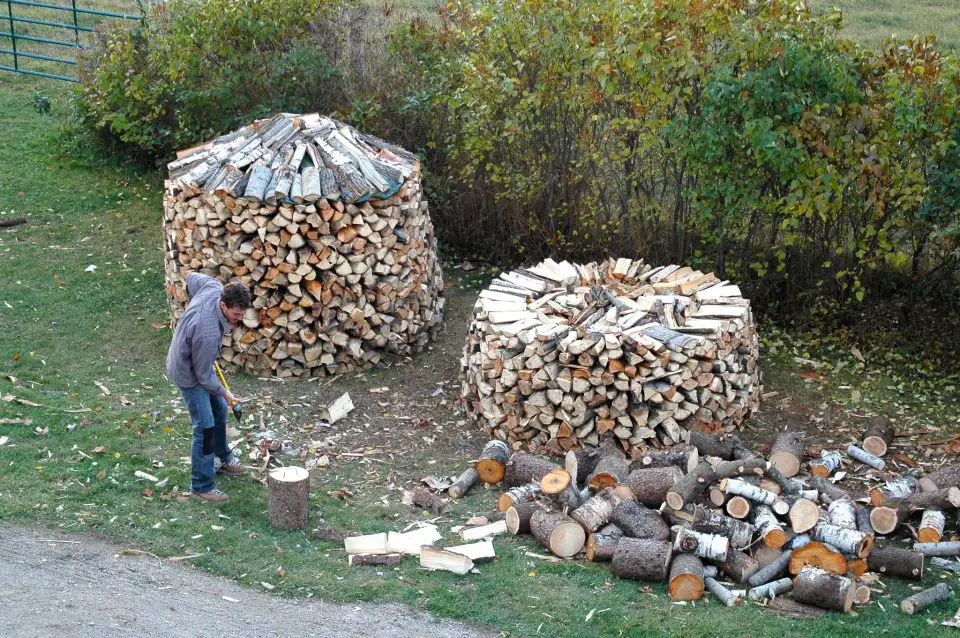
Round firewood piles solve several problems at once. They’re faster to build because you don’t need to stack every single piece neatly. The outer wall provides the structure, while the centre can be filled with shorter, crooked, knotty or irregular firewood (as well as good blocks) that would be annoying to fit into a straight pile.
They’re also stable. A round pile has a broad base, and the circular shape naturally resists tipping better than a narrow straight stack. When the pile is built with occasional cross pieces running through the middle, the structure becomes even stronger. For anyone who heats with wood and handles a large volume of firewood, the time savings alone can be enough reason to try this method.
How Round Firewood Piles Save Time
Traditional straight piles require each piece of wood to be placed with some care. The ends need to be stacked neatly, the rows need to stay straight, and the pile has to remain balanced as it gets higher. This is especially true if the ground is uneven.
With a round wood pile, only the outer ring needs that level of care. Once the outside wall begins to rise, the middle can be filled quickly. If you’re splitting wood near a tractor, trailer or wheelbarrow, the irregular pieces can be moved and dumped directly into the centre.This approach makes round piles especially useful when you have a mix of straight, crooked, short and odd-shaped firewood.
How to Build a Round Firewood Pile
Start by choosing a level, well-drained spot with good air movement. Mark out the circle, then begin stacking the outer wall with the best-shaped pieces. Place the wood so the ends form a stable circular wall, with each layer overlapping enough to hold the shape. I tie a 5-foot long rope to a 12″ spike to use as a compass for laying out the all-important bottom layer nice and round and even.
As the wall rises, fill the centre with the pieces that are harder to stack neatly. Once or twice during the process lay 10-foot poles across the pile from one side to the other. These cross pieces bind the structure together and reduce the chance of shifting and collapse. I learned this the hard way. A slight inward lean can help the outer wall stay stable. The goal is a pile that supports itself as it rises, rather than one that wants to bulge outward.
Do Round Firewood Piles Dry Well?
Yes, very well/ Firewood dries best when air can move through it and rain is kept off the top. Round piles may look dense, but they can dry surprisingly well when built properly. The outer wall allows air exposure, and the loosely filled centre often has plenty of gaps for airflow.
The top matters most. If rain soaks down through the pile, seasoning slows down. A simple solution is to place a tarp beneath the top layer of firewood so it acts like a hidden roof. The wood on top holds the tarp down, and the covered area settles gradually as firewood is removed. I have round 14-foot diameter tarps made of heavy fabric that I put on top of the pile after it’s built, with a single layer of firewood on top to hold the tarp down. This kind of cover keeps rain from soaking the pile while preserving the clean look of stacked wood. During winter, the round tarps keep snow and ice off the wood. Simply pull wood out from the perimeter of the pile and let the tarp settle downwards as the pile shrinks.
How Much Firewood Fits in a Round Pile?
Round piles can hold more wood than they first appear to. A tall, wide round pile uses vertical space well, which can be helpful when yard space is limited. The exact amount depends on the diameter, height, shape and how tightly the wood is stacked.
As a practical example, a 10-foot diameter round pile that reaches about 7 feet high at the peak can hold roughly 8 face cords of wood. This makes the method useful for people who heat with wood regularly and want a compact, attractive way to store a season’s supply.
Covering a Round Firewood Pile
The best firewood cover keeps rain off the top while leaving the sides open for airflow. Fully wrapping a pile in plastic can trap moisture and slow drying, especially if the wood is still green.
For round piles, a tarp can be placed under the top layer of firewood rather than simply thrown over the outside. This keeps the cover secure, protects the pile from rain, and looks neater than a loose tarp flapping in the wind. For a 10-foot diameter pile with a domed top, the tarp needs enough extra width to create useful overhang. That’s why my tarps are 14-feet in diameter.
Round Firewood Piles vs. Straight Rows
Straight firewood rows still work well, especially when they’re built on rails, pallets or another dry base. They’re familiar, easy to measure and simple to fit along a fence, shed or woodlot edge.
Round piles are different. They save time by allowing the centre to be filled loosely, and they can be more stable on uneven ground. They also look better in many settings and can hold a lot of wood in a compact footprint. The best method depends on your space, equipment and preferences. But if you’ve only ever stacked firewood in straight rows, round piles are worth trying at least once.
Firewood Stacking Tips for Better Drying
Good firewood storage starts with air and drainage. Keep firewood off wet ground if possible, or choose a site where water drains away quickly. Avoid stacking against the side of a building unless there is plenty of airflow and no risk of insects or moisture affecting the structure.
Split wood dries faster than unsplit rounds because more surface area is exposed. Stack firewood where wind and sun can reach it, and cover only the top once the pile is built. The goal is to shed rain while letting moisture escape from the sides.
Watch: How to Stack Firewood in Round Piles
The video above shows the round firewood pile method in action, including the basic structure, the outer wall and the way the centre is filled. It’s a simple approach that can save time while producing a stable, good-looking pile of wood.
And if yo stack firewood you probably cut it, too. The video below shows the usual methods I use to keep my chainsaws running well for decades.
Frequently Asked Questions
Is stacking firewood in round piles a good idea?
Yes. Round firewood piles can be faster to build, stable, attractive and space-efficient. They work especially well when you have irregular pieces that are hard to stack neatly in straight rows.
Do round firewood piles dry properly?
Yes, round firewood piles can dry well if they’re built with good airflow and covered properly on top. The sides should remain open so moisture can escape.
How do you stack firewood in a round pile?
Build a circular outer wall with the best-shaped pieces, then fill the middle with irregular firewood. Add long cross pieces every few feet of height to tie the pile together and improve stability.
Why are round wood piles stable?
Round piles have a wide footprint and no unsupported straight ends. The circular shape resists tipping, and cross pieces inside the pile can help bind the structure together.
Should firewood be covered with a tarp?
Firewood should usually be covered on top, but not wrapped completely. Covering the top sheds rain while leaving the sides open for airflow and drying.
How much firewood fits in a round pile?
The amount depends on diameter and height. A 10-foot diameter round firewood pile built to about 7 feet high at the peak can hold roughly 8 face cords of wood.
Is it better to stack firewood in rows or round piles?
Both methods can work. Straight rows are simple and familiar, while round piles can be faster, more stable, more attractive and more space-efficient.
How high can you stack a round firewood pile?
Round piles can often be stacked 6 feet high or more if they’re built carefully with a broad base and internal cross pieces. Stability should matter more than maximum height.
Does firewood dry faster stacked or piled loose?
Stacked firewood usually dries better than a loose heap because air can move around the pieces more predictably. A round pile combines stacked outer walls with a looser centre, giving a useful balance of speed and airflow.
Should firewood touch the ground?
It’s best to keep firewood off wet ground when possible. If that’s not practical, choose a well-drained spot and avoid low, damp areas where the bottom layer will stay wet.
How long does firewood need to season?
Seasoning time depends on species, climate, split size and storage method. Many hardwoods need at least 6 to 12 months, and dense species may need longer for best burning.
What is the best place to stack firewood?
The best place is sunny, breezy, well-drained and convenient to access. Avoid damp hollows and avoid stacking wood tightly against buildings.





I hope you found this content useful!
Your generous support helps me produce more practical, hands-on content that I hope you’ll find useful.
Steve Maxwell