0:00
So in this video I want to share a little trick that I use for mixing paint products
0:05
I don't always use this. Sometimes, as with urethane, say for instance
0:10
there's not a whole lot to mix up, so I'll just mix it with a stir stick
0:14
But with some paints, and especially wood stains, there's a case to be made for power mixing
0:21
which is what I'm going to show you here. So I've got a can of some brown stuff. I really like this color for staining
0:30
Let me just show you the problem. So I mean it looks brown enough, right, when you're looking at it
0:36
but the problem with stains is, oh boy, they often build up, look at that
0:41
They often build up solids on the bottom, and that's where the color comes from, or some of the color
0:47
And it's very important that that whole thing be mixed, that there isn't anything left on the bottom
0:52
because you're not going to get the kind of coloring action that you want, if that's there
1:00
Now, I could mix this so that it's homogenous with just this stir stick
1:06
The problem is, it's going to take me a long time, and there's a very good chance that I'm not actually going to mix it as thoroughly as I should
1:13
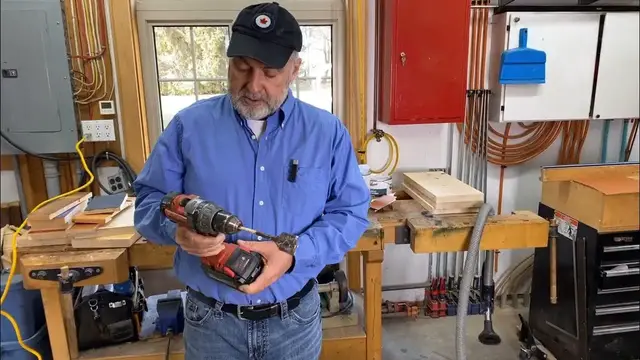
So that's where this comes in. This is my paint mixing paddle
1:19
And once upon a time, it used to be one of these. It used to be a spade bit
1:27
But I retired it, or rather reassigned it, for another job. I ground off, you can see I ground off most of the spur, because if the spur is long, I can't get to the bottom of the paint can
1:38
So I ground off most of it, and I just use that one for all kinds of paint
1:42
Sometimes house paint, sometimes stain, sometimes some outdoor wood finishes. So, I'm just going to put it in. Now, there's a couple of things I've got to warn you about here
1:54
If you have this thing set to go really fast, well, chances are excellent, whatever you're stirring is going to come flying out
2:01
So you want to be careful. You don't want to rev it up too much. You don't really need to
2:06
And you want to make sure you're... it's really the bottom that we're working on
2:10
That's where all the stuff has developed, all the sediment. So we want to get it right down to the bottom
2:16
So, as you're going to see, I'm going to rotate it around the can, sort of move it back and forth, cover all the areas
2:20
Then I'm also going to reverse the rotation and spin it the other way, just to make things a little more mixed
2:27
But it's really a pretty simple process. Now, what I want you to look at here is how the appearance of this stain changes
2:36
Because right now, it looks like black coffee, which is darker than the stain is supposed to be
2:42
And that's because all the good stuff is at the bottom. But as I mix..
2:57
We're starting to see some lighter brown come up. You see that
3:01
So I'm going around in a circle to make sure I get all the stuff on the bottom, and then I go back and forth
3:20
I'm also going up and down a little bit, to pull that lighter stuff up from the bottom
3:32
Now, this mixing, as you can see, it's not happening immediately, even with this power tool
3:40
So you can get a sense of how long it would take to mix thoroughly by hand, just with a stick
3:56
I'm going to reverse rotation a bit. I'm not sure that that helps, but I'm kind of thinking it might. It can't hurt
4:07
Now that looks pretty even to me. Now that's pretty even, and it's ready to go
4:22
Now, I would normally be doing this right before I'm staining. So I would have a brush and a rag, and I would clean this off, and then use some of that on the wood that I'm going to be staining
4:33
But it gives you the idea. And power mixing like this really helps with a lot of different finishing substances that you're likely to use