Up next in 10



❓ Submit your questions to be answered on the show:
► [email protected].
🔔 Subscribe and never miss an upload:
► http://bit.ly/BLRchannel
✅ *_Step-by-step_* plans to build your life of *_true freedom:_*
► https://baileylineroadlearning.com/
🏡 Free, expert advice to *_build and customize_* your dwelling:
► https://baileylineroad.com/
📌 Viewers like you *_love_* these playlists:
► Winter Tips - https://bit.ly/2rpnUcm
► Product Tours - https://bit.ly/2L2H54Q
► Woodworking - https://bit.ly/2RN83jC
► Real Rural Life - https://bit.ly/2RI5dvY
🌎 I’m on your favorite platform:
► https://linktr.ee/baileylineroad
Show More Show Less View Video Transcript
0:00
In this video, I want to talk to you about dust collection as it relates to table saws
0:05
Now the whole topic of dust collection in a wood shop is pretty big and I don't have room to go into everything here, of course
0:11
but it is important to think about dust collection at the same time you're thinking about table saws because
0:18
dust collection is pretty important and not just for your health, not just for the cleanliness of your shop
0:23
but it's just nicer to work with wood when you're not always covered in dust and everything in your shop gets covered in
0:29
dust too. So I'm going to be going over six topics here. Why is collection important? How does the
0:36
dust collector work? Choosing a dust collector, connecting a dust collector to your table saw
0:43
using that dust collector, and kind of the related topic of ambient air cleaners. So why is
0:53
dust collection important? Well, this is a picture of my workshop. It's a separate building next to my
0:59
house, it's nice and clean. Now, actually, in this photo, I took it before I had my dust collector
1:05
installed, but this is the goal to have a shop that looks like this. Now, I should mention that
1:13
no dust collection system is 100%. You can have the best system going. You're still going to have
1:19
some dust. But the main thing is that you capture as much dust as possible, and especially as much
1:27
of the fine dust as possible. I mean, you know, sawdust can be big chunks
1:31
It can be very tiny particles, even particles that are too small to see
1:36
So you want to get as much as you can, and especially of the fine stuff
1:43
which is damaging. It lands on everything, and it's kind of a pain
1:47
So this is pretty basic stuff, but a dust collector is a machine
1:55
that moves a lot of air. And I mention that just because there are other things that move air too
2:05
like say a shop vac. And shopfax actually move air faster than a dust collector
2:12
but the volume moved by a shop vac is much lower. So the claim to fame with dust collectors
2:18
is that they move large volumes of air. And that's really what you need for effective dust collection
2:25
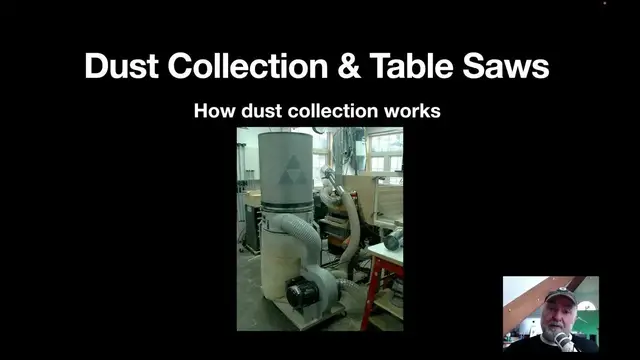
What you see here is one of the dust collectors that I own
2:30
and that sort of thing on top you see, that's the filter
2:37
So the air that is drawn in by the collector passes through that filter and then into the shop again
2:46
So the quality of that filter is very important, and it can vary quite a bit too
2:51
you want a filter that will remove dust down to about one micron in size, which is very tiny
2:59
The larger particles will fall down into that plastic bag, you see
3:04
and that's the stuff you can take outside and use it as some mulch in your garden
3:10
or do different things with it. Inside the filter itself, that's the top part of the collector
3:18
very tiny particles will cling to that and eventually reduce the airflow So all dust collectors of the sort you see here have a mechanism that with a handle on it allows you to kind of knock the dust off
3:31
the very fine dust from inside that filter. And that's kind of standard practice
3:38
You just give the handle a couple of shakes every so often and it keeps that high volume of air flowing
3:45
Like I said, you've got to move a lot of air in order to collect this kind of dust
3:49
And when you do that, the fine dust falls down into the bag, and you can take it out that way, too
3:54
So that's essentially how it works. The collector is connected to machines with two kinds of pipes
4:02
The main network is rigid pipe, rigid steel pipe. But it's very difficult to connect rigid steel pipe to every single machine
4:13
So the last little run is usually done with flexible pipe. That lets you to move the machine around
4:19
a little bit. It makes it a whole lot easier to make the connection because you're not
4:22
precisely cutting a certain rigid pipe to length. It's possible and actually that's how
4:28
very large woodworking machines are usually plumbed into a dust collection system
4:32
with rigid pipe all the way because it's smooth on the inside and it maximizes airflow
4:37
But there's no reason to worry about the perforations or the the corrugations of the flexible
4:46
pipe because it all still works very well. And you'll also notice on this photo, sort of in the, near the middle, up a little bit
4:57
you can see a Y-shaped pipe there. At the top end of that Y-shaped pipe, there's a blast gate, which allows you to shut off
5:07
or turn on the vacuum to different machines. Because you really only want to have the vacuum functional for the machine you're
5:16
using. That maximizes the collection power for that machine and that makes a big difference. So blast
5:22
gates are also part of the equation. All of mine are manual, but you can get some that are automatic as
5:28
well too. But like I said, that's part of a larger discussion of dust collectors. So choosing a dust
5:36
collector. This collector here is one that I also own and I'm working it into a new
5:46
workshop that I'm setting up. And this brings me to the topic of size. If you have just a one-person shop
5:54
and you're only going to be using one machine into time, presumably, then I think the minimum size
6:00
you'd want would be one and a half horsepower. And that'll function fine for you. If you want
6:09
some more power, you can look at two horsepower. This particular model is a three horsepower, and
6:15
that moves a lot of air. And the more air you move, the more effective your dust collection is going to be, too
6:22
So there are five horsepower units that are even larger than this, and that's for multi-purpose shops
6:28
They do get really, really big, too, much more than five horsepower in industrial situations
6:33
but that's not really what we're talking about now. So essentially, your first decision would be what sort of power do I need
6:41
One and a half would be minimum. two is better three horsepower is even better than that Now this is that a close of that point I mentioned before with the Y pipe What you see here is the vertical pipe coming down
6:59
That's part of a network that goes along in my case, the ceiling of my shop
7:04
with drops going down where I need dust collection for different machines
7:09
I should mention something, though. some people are tempted to make the rigid part of their system with the kind of
7:17
snap together pipes that might be used for say a forest air heating system
7:22
but I recommend against that because that pipe believe it or not is not really strong
7:28
enough to do a good job in fact some of the lighter stuff can actually become
7:33
collapsed it can actually collapse in on itself in times of high suction
7:40
So the stuff I've got here is what they call spiral pipe
7:45
That refers to that sort of angled berm you see on the vertical pipe
7:51
And that stuff's very, very strong. And it works very well. You need to think of this like an investment, a long-term investment
7:59
If you're going to be doing dust collection at all, you might as well do it right. And spiral pipe is the best for this sort of thing
8:06
You'll also notice the blast gate, as I show. This gate is closed. There's a slide
8:12
You can move it back and forth to either open or close, the connection to that machine
8:20
Kind of interesting, too. Everybody knows what duct tape is. It's not duct tape, quack, quack, it's duct tape, D-U-C-T
8:30
So you'd naturally think that duct tape would be good for ducts, but it actually isn't. It's not good at all
8:35
I've never seen any that is good because it's cloth-based and it creeps over time and it de-ceteen
8:40
lamp you know the cloth delaminates from the adhesive in a few years far far better is what you see
8:47
here which is aluminum tape you can see that in the connection between the spiral pipe and the
8:53
y aluminum tape works great it's it seals very well and it never lets go you'll also see if you
9:02
look closely there's a screw head on that connection where the aluminum tape is that's necessary
9:08
to hold things together too i just use self-drilling screws for that sort of thing
9:13
And then there's the flexible pipe that's connected to the rigid stuff
9:18
with a screw clamp. And that's really how the network is built
9:25
Now when it comes to a table saw, there is something that makes a big difference
9:29
and that's what this image here is about. You'll notice that there's sawdust on my saw
9:36
And like I said before, no dust collection system is perfect. But the saw dust that's hanging around is fairly coarse
9:43
It's not going to float around. It's not going to go very far. It's the fine stuff you want to collect
9:48
And that's why I really like what you see here, which is called an overarm table saw guard
9:54
So not only does it provide more safety by shrouding the blade during a cut
9:59
but it also has a port for a small dust collection pipe
10:04
which catches the fine dust that rises off the top of a cut
10:09
while you doing it Now since I took this photo I added a little blast gate to this as well so that I can close it off completely when I want to use say my jointer when I want to direct all of the
10:22
dust collection suction to that. Or my edge sander, I have a stationary edge sander. That thing
10:29
makes a lot of fine dust. So I want to direct all the suction power to that when I'm using it
10:35
And also, this pipe comes off, just slips off of the over our
10:40
guard and I hook it up to my router table when I want to do some routing as well
10:45
So every shop situation is different and you're going to have to use a little ingenuity
10:51
to optimize what you've got, but I'm hoping these ideas provide you with some food for
10:57
thought so how you can make this work well for you. Well, I mentioned before several times that no dust collector is perfect and it's the
11:07
airborne dust that's really a... pain. It's a health issue. It's, it gets everywhere. It makes a mess. And that's why they invented
11:16
ambient air cleaners, which is what you see here. They essentially just a box with a fan in it
11:25
And the fan draws air through a filter and then back out into the room. And they hang from the
11:32
ceiling, so they're out of the way. And that's kind of where you want them anyway, because they're
11:36
going to get the most air flowing through them that way without obstructions and you're not
11:43
going to trip over it or have to make room in your shop for it. The filter on the collector
11:49
on the cleaner on the right, needs cleaning. And that's what a dirty filter looks like
11:57
I never clean them inside the shop. I always take it outside because you know
12:01
you want to get that dust out. And so, And the dust is fine, too
12:08
So I always do my cleaning of filters outdoors just to keep everything as clean as possible
12:15
Now here's another thing, too, that's a bit surprising. The very fine dust, the invisible stuff that floats around, it can float around for a long time
12:25
So it's always a good idea to let your ambient air cleaner run for a while
12:31
even an hour or two after you've stopped making sawdust. because it takes time to circulate all the air
12:39
and to filter all the air and to capture things. But don't make the mistake of shutting off your ambient air cleaner
12:45
immediately after a work session or even after you've shut off the machine
12:50
because it needs time to work. And they're quiet. They're not obtrusive at all
12:56
Far quieter than the machines you're using. So by all means, let that thing run
13:01
They all have timers on them so you can turn them on
13:05
and you can say, well, you know, stay on for an hour, you know, after I've activated the timer or whatever
13:12
And you'll get, you'll get practice with this and pay attention to the filter
13:17
pay attention to how dust might be settling in the rest of your shop, and that'll give you some guidelines for how exactly you should use something like this
13:27
Well, that's in an nutshell. And, you know, like I said, I'm a big fan of dust collection
13:32
don't forget it. Give it some thought and work it into your plans
13:37
for equipping your woodshop
#Home Appliances
#Home Improvement
#Construction & Power Tools
#HVAC & Climate Control
#Warehousing
#Industrial Handling & Processing Equipment
#Vacuums & Floor Care
#Household Cleaning Supplies
#Air Filters & Purifiers
#Household Supplies