Up next in 10


MY ONLINE COURSES:
► My Cabin Building Course: https://bit.ly/36bRARX
► MIG Welding for the Home Workshop: https://bit.ly/3CGuUFv
► Woodworking for Beginners: https://bit.ly/3w6ZnLW
► How to Build a Deck: https://bit.ly/3i2LWV3
► Build Traditional Wood Cabinets: https://bit.ly/3JbLQ9v
► Renewable Energy for Your Home: https://bit.ly/3w9K4ls
► 3 Solar Energy Projects: https://bit.ly/3KLNUp9
READ MY POPULAR ARTICLES ABOUT:
► Polyurethane Finish - https://bit.ly/powerbuffing
► DIY Hoop House Plans - https://bit.ly/hoophouseplans
► Submersible Pump Installation - https://bit.ly/pumpinstallation
► Air-Drying Wood Tips - https://bit.ly/wooddrying
► How to Build a Table - https://bit.ly/tablebuilding
► How to Stain a Deck - https://bit.ly/deckstain
► Choosing Waterproof Outdoor Glue - https://bit.ly/exterioradhesives
► How To Build A Wheelchair Ramp - https://bit.ly/wheelchairrampplans
SUBSCRIBE: http://bit.ly/BLRchannel
Show More Show Less View Video Transcript
0:00
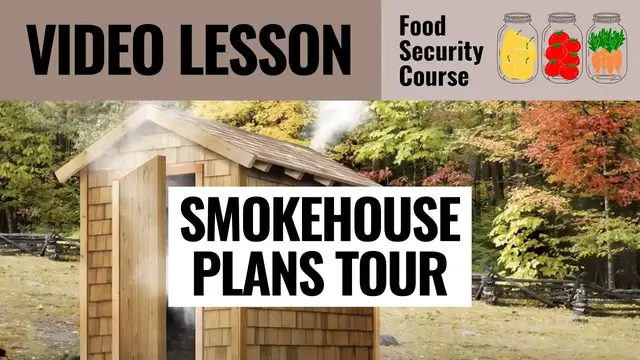
This video is about helping you understand the smokehouse design better
0:05
so you can build it with more confidence. So this is what it looks like. It's really a small wooden building
0:12
It's built fairly tight. Animals can't get in. It's got something of a raised floor in order to help deter animals from digging in
0:22
Over here we've got the firebox. In this case, this is a chunk of concrete well tile, about 30 inches in diameter
0:32
And there's been a hole cut in the side to accommodate a door
0:36
And there's a lid on top. So there's a small smoldering fire that burns in this firebox during use
0:45
And the smoke is transmitted to the smokehouse with an underground pipe
0:50
It's sloped upwards slightly and it leads into the smokehouse and comes up through the floor
0:56
The main advantage of this approach is that it will deliver cool smoke to the smokehouse
1:04
That's pretty important because it's pretty easy to have the smoke be too hot
1:09
and to end up cooking and drying out the meat instead of impregnating it with smoke
1:15
to deliver flavor and preservative qualities. So the separate firebox here does a great job at cooling the smoke
1:26
It also greatly reduces the fire hazard. You know, there are some smokehouse designs that have the firebox inside
1:35
but that's a little riskier. It makes more sense to keep the fire out and well away from the wooden structure
1:42
So this is why this is a traditional approach. It works really well. It's safe and it's time-tested
1:50
If you take a look here at the plans, there's lots of things to think about
1:56
So we've got the concrete firebox here, as I explained, and then there's the underground pipe
2:03
A concrete pipe works really well here. Besides being completely fireproof and it can't melt and it won't rot
2:11
it also helps to cool the smoke as well. You can find concrete pipes like this from outfits that sell sewer supplies
2:20
Now, your first step will be to install the support posts. The design here is a kind of a pole barn structure
2:30
So we've only shown one post going down below the surface, but it would be the same thing for all the posts
2:40
The ones on the corner and the intermediate posts here. Also, the posts that flank the door, too, should be supported in this way
2:50
Sinking the posts in makes for a very rigid structure. There's one trick here, though
2:57
You never really know how deep to make the holes. I mean, they need to go down below the frost line
3:03
but their relative depth from one hole to the next can vary quite easily
3:08
and that will throw off the levelness of the tops of all these posts
3:14
So as you can see, this top here, this top here, this top here, all the way around
3:19
they need to be at exactly the same height. They need to be level, they need to form a level plane
3:24
and they need to be the same as each other. The only way you're going to get that to happen is if you set the posts
3:30
there's a concrete pad here in the bottom of the hole to give some extra bearing capabilities
3:37
It's a very simple thing to do, and it adds a lot of strength
3:41
And then the posts, and the soil is filled in around the posts and compacted down in there, and the posts are set plumb
3:48
so that's straight up and down, but they're longer than they need to be
3:52
They have to be longer at this stage, because what you need to do when they're all up
3:56
is that you mark a level point on all of them, all the way around
4:01
And then you go and you cut off the posts as they're sticking straight up in the air
4:07
Now that's a bit of a pain, because you have to be working from a ladder
4:11
a step ladder, or a little scaffolding, or something like that. So it's not that convenient to be sawing posts when they're vertical
4:17
off the ground like that, but it is the only way to get all the tops level
4:22
So you'll need to do that. The next step is to cut and install some beams
4:28
that connect all the posts. And you'll see here there's a lap joint
4:34
so this front beam here overlaps and meshes with this side beam here
4:42
And then 12-inch spikes, 12-inch hot-dipped, spiral-shaped, galvanized spikes
4:53
need to get driven down through this. Now, never ever try to drive a big spike like this
4:59
without first pre-drilling, most of the way through all these beams, and then most of the way into the posts
5:05
That's the only way you're going to get a split-free result, and it's the only way that the spikes are going to keep on going down the way they should
5:15
without veering off to one side. So you'll do the spike thing here
5:19
We don't really need a lap joint here for these smaller 4x4 door posts
5:26
that flank each side of the door. Just the spikes alone will be fine
5:31
and the bottom is sunk down below the ground, like I explained
5:35
So this will give you your frame. You have your uprights, you've got your beams along the top
5:40
and things are starting to look a little bit like a smokehouse at this stage
5:46
The next stage in the construction process involves fastening some boards on the outside
5:53
so to fill in the walls. Now you might be thinking, I don't want to bother with boards
5:59
I'll just put up some plywood, or heaven help us, some OSB
6:03
and that'll be good enough. Well, if you want to have a good enough smokehouse
6:08
then I guess you can do that. I would never use OSB
6:13
because it's got all kinds of urea formaldehyde glue, and I can't guarantee that some of that won't make its way onto your food
6:23
if it's sitting around the outside of everything. Same goes for plywood, although to a much lesser extent
6:29
The glue that holds the laminations of plywood together is urea formaldehyde glue as well
6:34
so not the greatest stuff to use. What I like is 2x8 or 2x10 planks
6:43
Now, you might be thinking, well that's pretty thick, we don't need them that thick
6:47
I think structurally speaking you don't, but 2x8s and 2x10s are pretty common
6:54
and in my experience, a 2x10 construction grade spruce, for instance, can actually be no more money than a 3 quarter inch sheathing grade pine
7:08
So, that's what first got me onto this. I realized I wasn't going to pay any more for the extra wood
7:12
and there is a substantial advantage, and that advantage is that the nails that are going to hold on
7:18
in this case cedar shingles on the outside, to waterproof this thing
7:23
and to seal it better so that the smoke can't get out, those nails will be completely hidden by wood this thick
7:30
Whereas if I went with 3 quarter inch sheathing, which technically would be thick enough to work
7:36
I'm going to see nails or staples on the inside, whatever I use
7:40
and I think that's ugly and unnecessary. So, I recommend 2x8 or 2x10 lumber sheathing for the walls
7:48
That will also give you some more strength, some more thickness of solid wood to mount things on the wall
7:54
if you want as well. A shelf or a hanging hook for whatever you want to smoke in there
7:59
So, it makes good sense to go the extra mile with this thicker sheathing
8:05
The building is small too. It's not like it's going to make a huge difference, whether you use something cheap and dirty like OSB or some 2x10 lumber
8:14
It's not going to make a difference to your financial bottom line, and you're just going to get a much better smokehouse
8:19
if you use some fairly thick sheathing. The next step after wall sheathing is to cut and install your rafters
8:28
That's what you see going on here. And if you look at the next page of plans
8:34
you'll see some detailed information for cutting rafters to fit this building
8:40
Now, if you want to make your smokehouse longer than this, then that's not going to affect rafter design
8:46
But this rafter design is specific to this width of building. And when you cut the rafters, don't cut a whole bunch of them at once
8:56
Just cut one pair, and then test them out. Test them out at this end of the building
9:02
test them out at that end of the building, test them out in between, just to make sure that they fit properly
9:08
Because the angle and the location of the bird mouth pocket that you see here
9:15
the angle of the top, it all enters into the equation. And before you cut more rafters than you need to
9:22
or rather before you miscut some mistaken ones, you want to make sure they fit properly
9:27
When you do your trial fitting, you're going to need a little scrap of wood here too to simulate the existence of the ridge board
9:35
as you go and test in the different positions. Now, there's one other thing I need to talk about
9:41
before I leave the topic of rafters, and it's this rafter blocking that you see here
9:47
There's a side view of it here. When the rafters rest on the top of the wall
9:53
they of course don't go all the way down. There's this bird's mouth pocket here
9:58
and this little space here is the amount that the rafter sticks up above the wall
10:07
So that's going to be open, unless you do something about it
10:11
And that's where the rafter blocking comes in. It's cut at an angle on the top, 30 degrees from square
10:19
and it fits between the rafters as the rafters go down. And the idea is that it fills up the space from the top of the wall frame
10:28
right up until the underside, or what will be the underside of the roof sheathing here
10:34
So, it's not that a smokehouse really needs to be that tight of a building
10:41
but you definitely want to do everything you can to keep critters out
10:45
And even if you don't have meat that's sitting in the smokehouse
10:50
between uses, you don't want squirrels or chipmunks or mice or anything
10:57
to be climbing up in here and having their way inside the smokehouse
11:01
So, take the time now to seal this. There's no better time to do it than now
11:05
Once your roof boards are on, you really can't plug this area up nearly as easily
11:12
So, make sure you do this after the rafters are in, but before the roof sheathing goes down
11:19
and you'll have a nice, tight eaves area. There's one other thing I forgot to mention before
11:27
and that has to do with the kind of wood that you use for the posts
11:32
and for the first bottom courses of the wall sheathing. Now, once upon a time, pressure-treated lumber was made rot-resistant
11:41
with something that was arsenic-based. And there was reason to be concerned about food safety
11:48
around something that's got arsenic in it, but it's been a long while now since arsenic-based pressure-treated lumber
11:56
was available for sale to ordinary people. Nowadays, the active ingredient is copper-based
12:04
so not nearly as toxic. I mean, copper is not an issue, at least not to human beings
12:10
So, that's why I personally have no trouble using modern pressure-treated lumber for the posts
12:18
and also for the bottom couple of runs of wall boards, because these are going to be in contact with the soil
12:27
or pretty close in contact with it. They're also going to get water splashed on them
12:32
You know, the shingles will cover them too, but there's going to be a fair amount of moisture down here
12:37
So, I personally have no issues using copper-based pressure-treated wood for these bottom runs, the bottom lengths of wall sheathing
12:50
Now, you may feel differently. You may want to use cedar instead, if you can find it
12:55
Cedar's rot-resistant not so much as pressure-treated lumber, but it's better than just straight pine or spruce or fir or something like that
13:04
So, just keep that in mind as you're selecting materials, because when you get close to the ground
13:09
you do want to have something that resists rot pretty well. Just another few things before I finish up on the smokehouse plan tour
13:19
If you look at this view, what I recommend here is that you install the gable wall boards
13:27
before you put on the roof boards. That way, if one of the gable wall boards sticks out a little bit further than it should
13:34
you can easily trim it off flush with the top of the rafter before the roof boards go on
13:39
Now, because we're dealing with fairly thick wall boards here, there's no need to support them in the gable area
13:52
They will be strong enough on their own without any kind of intermediate support
13:57
Now, when it comes time to put the roof boards on, once again, I'm recommending some thicker material, 2x8 or 2x10
14:05
It delivers a lot of strength and solidity, and there'll be lots of room for you to sink shingle nails
14:12
without it showing through in an ugly way underneath. So, typical shingle nails are about an inch and a quarter long
14:19
and that will be nicely hidden within the inch and a half thick roof boards
14:26
because don't forget that 2x8s and 2x10s actually only measure an inch and a half
14:33
And just one more thing here on the back. Some sort of a hinged smoke flap would be helpful
14:40
because if your building is too tight, then the smoke won't be able to travel from the concrete firebox
14:48
through this slightly upsloping smoke pipe. Because if the air is in here, in the smokehouse, and it won't leave
14:58
then it's going to restrict the travel of smoke through the house as well
15:03
So you'll want this smoke flap on the back, so you can open it more or less
15:10
so that you have a good flow of smoke through the whole house
15:15
to give you some good results on anything that you're preserving in there
#Home Improvement
#HVAC & Climate Control
#Fireplaces & Stoves