0:00
Now this is from Martin. He's a woodworker. I came across your article on my web page URL there. I
0:13
found it very interesting and insightful. I'm a semi-retired serial technology entrepreneur based
0:19
in Ottawa, Canada. I'm also a building stuff with wood enthusiast. You know, so am I. Lately I've
0:27
been extending my search radius of smaller mills in attempt to find more affordable wood suppliers
0:33
Well that's certainly reasonable. Wood can get pretty expensive especially if you're going for
0:38
something other than you know standard basic softwoods. I'm certainly going to leverage the
0:45
advice in your article for softwood. Do you have any similar tips for sourcing hardwoods? Well the
0:52
article on softwoods that Martin is referring to has to do with my recommendation that construction
1:02
grade lumber of the right kind normally sold for house frames actually is pretty good material for
1:09
fine woodworking. Now when I say that to a group of woodworkers I usually run into some opposition
1:15
They say oh you don't know what you're talking about. You don't know what fine woodworking really is. But I can assure you that if you choose the boards correctly you can make some marvellous
1:25
stuff out of construction grade lumber. There's some exceptional boards that just get sold for
1:32
floor joists or whatever from lumber yards everywhere. Softwood for construction is not
1:39
graded for quality in terms of furniture building. I mean it is graded but you know from a house
1:47
framing point of view if you have a 16 foot long 2x10 and it's perfectly clear and knots and it's
1:53
got some interesting grain in it nobody pays attention to that. Nobody's going to charge more
1:57
for that board and those are the kind of boards that can turn into some really nice woodworking
2:04
projects for you. You won't find any wood any cheaper than that and believe it or not contrary
2:13
to popular wisdom the spruce pine and fir lumber that is sold for building frames here where I live
2:20
takes a finish beautifully. I'm going to be going into more detail about this later in the show but
2:27
Martin's particular question is about hardwoods which of course there's no such thing as construction
2:32
grade hardwood. All house frames at least in my part of the world are made the softwood because
2:37
it's a lot easier to work with and it's plenty strong but Martin lives in an area where there's
2:45
a lot of forests around the city of Ottawa and I don't know the scene too well in that region but
2:53
I can assure you and Martin that there will be small small sawmills around that are cutting
2:59
lumber from local logs and some of that's going to be hardwood too. The mills are one of
3:06
two types. There's a stationary mill where the logs are brought to the mill and then they're cut
3:10
These are easier to find because they don't move around and they're pretty big and they look like
3:14
a sawmill but then there's also portable sawmills which are almost always big band saws on a track
3:22
and those mills go to the forest so someone will cut some lumber, some timber worthy of sawing
3:32
into lumber, they'll drag it out to a clearing somewhere and then the guy with his portable
3:37
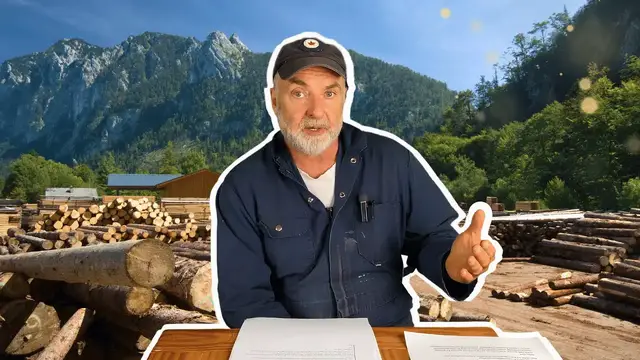
band sawmill will come and start cutting up into boards. So how do you find these people? Stationary
3:43
or traveling band sawmill. Well the internet's a great thing for that. When I was
3:50
answering Martin's question by email I did a quick Google search for sawmills near Ottawa and that
3:58
could be anywhere. Small sawmills near Louisville, Kentucky or small sawmills near Edmonton, Alberta
4:06
It doesn't really matter and in most cases, every case I've ever seen, there's some listings that
4:13
come up. So you need to connect with these people and you know make a deal on some boards. You're
4:17
going to find that usually they're very very good to deal with. Certainly there's a handful of small
4:24
small sawmills where I live and you get to know the people and they let you pick through
4:29
their lumber pile. Just be sure to return the lumber into a nice pile when you're done. If you
4:35
don't want to wear out, you're welcome. But you can get wood there that way for maybe half the price
4:42
of retail. Now in most cases you're not getting kiln dried wood so the wood hasn't gone through
4:50
some sort of a chamber, a heated chamber in order to dry it out faster. But I actually consider that
4:56
a bonus because wood that's been air dried, so not kiln dried, is actually a lot nicer to work with
5:05
It's less brittle, it planes better, it sands better. I really like it and there are plenty of easy ways
5:14
to reduce the moisture content of your lumber so it works well for interior projects
5:20
without having to use a drying kiln. So in fact the best lumber in the world for fine woodworking