Up next in 10



SUBSCRIBE: http://bit.ly/BLRchannel
WATCH MY POPULAR VIDEO: How to Cut Perfect Miter Joints
https://youtu.be/0wnjJ-Xi5FU
WATCH MORE BAILEY LINE ROAD:
Winter Tips - https://bit.ly/2rpnUcm
Product Tours - https://bit.ly/2L2H54Q
Woodworking - https://bit.ly/2RN83jC
Real Rural Life - https://bit.ly/2RI5dvY
CHECK OUT MY WEBSITE: https://baileylineroad.com/
My Cabin Building Course: https://baileylineroad.com/cozy-cabin/
How-To & DIY eBooks: https://baileylineroad.com/shop/
SOCIAL MEDIA:
http://bit.ly/STEVEMyoutube
http://bit.ly/STEVEMfacebook
http://bit.ly/STEVEMtwitter
Show More Show Less View Video Transcript
0:00
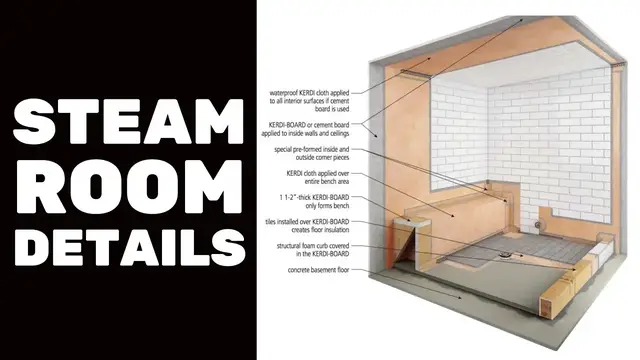
This video will highlight details of a steam room if you wanted to build something like this in your basement
0:08
It's really very similar to building a shower stall as well. The steam room has a lot of steam and moisture in it, but the temperatures aren't all that high
0:18
They're certainly not as high as a sauna, so you can use the kinds of materials that you see here
0:24
These materials would definitely not be suitable for a sauna. So you don't want to change your mind
0:29
You don't want to change your mind partway through and turn something like this into Toma
0:33
Now, the products that are shown here are made by Schluter. By now, you might be thinking that this whole course is a Schluiter commercial
0:42
It's not. I don't have to recommend these people. But they just make terrific stuff
0:48
And it's unique stuff, too. You're not going to find any other manufacturer that offers the kinds of things that you see here
0:56
And one of the most surprising things, is this curdie board foam
1:02
This is a structural foam component, or a tight-grained, fine-grained kind of foam
1:09
with a layer on both faces. And this foam does two remarkable things
1:16
I mean, first of all, this layer, which is kind of paper-like
1:20
it's completely waterproof, though, is meant to accept a thin-set mortar as an adhesive
1:27
and the same stuff that you'd use to set tiles on any kind of a floor surface is what you'd use to fasten tiles to this foam
1:37
And it sticks really well. It's engineered to accept thin set mortar and it sure does a good job
1:46
Maybe more surprising than that though is that the thin set mortar is also useful for gluing these pieces of foam together
1:55
So they taken a material that already being used by tile setters and now they using it as an adhesive And in fact it so strong that you can actually make in this case a bench out of it
2:08
And that's what's going on here. There are specs for this and, you know, benches of a certain size and width need to be made of a certain thickness of curdie board
2:17
So this video isn't about all those details, but it's just alerting you to the fact that you can do this stuff with this material
2:26
So it's completely inorganic, it's completely waterproof, and it glues together with thin set mortar
2:35
So that's what's going on with the bench. Something similar is going on here with this curb
2:42
Schluter also sells a foam curb, so it's ready to go. It's the right shape to act as a curb for a shower stall or for a steam room like this
2:53
and it's all ready to accept tiles straight away. Now, another component to the system here is called curdie cloth
3:03
And this is kind of a non-woven synthetic fabric that repels water like crazy
3:10
I mean, I'm not really sure how it works, but I've taken material like this, curdie cloth
3:16
and I've formed it into a funnel with nothing sealing. So imagine a circle
3:21
You take a circle of the material, and you cut from the outside to the inside
3:26
and you kind of fold it over itself to make a cone. And with nothing on the joints at all to waterproof them
3:34
it holds water. You can just put water in this cone and there's kind of electrostatic repulsion
3:40
or something like that. And the water just never gets through these joints
3:44
So it's a highly waterproof material and it also glues down with thin set mortar
3:49
So that's what you've got going on here as added protection. over the bench The curdy cloth comes in different kinds of pieces too So you got an outside corner piece like you see here in an inside corner piece and you know there narrower strips for doing small joints and things like that So it just
4:12
it just works tremendously well. Another thing that Schluter offers is the hardware strips like
4:18
you see here and further up. Now it's difficult to tell what these strips are doing at this stage
4:25
But in practice, there's all different kinds of profiles, and they're useful for ending a run of tiles in an attractive way
4:35
So there's corner ones like this. There's ones that go along the edge
4:39
There's dozens and dozens of different shapes. And they just make tiling look better
4:44
especially around the corners and things like that. So when it comes to the floor, I would recommend putting a layer of curdie board down on the floor
4:54
The same way that I showed you how to how to do that when you've got an electrically heated floor and you want to put tiles on top
5:04
You know, you don't want to have cold feet in the steam room, so you might as well insulate that floor too
5:10
Schluter's got some drain stuff that's meant to work with the whole system
5:15
So that's something to keep in mind. When it comes to actually generating the steam, there are units out there that are meant for this
5:24
There's steam bath generators, steam generators. And they plug in and they take water and they make steam and a certain amount of heat
5:35
So you've got this nice, warm, steamy environment. In the same way that there are electric units that heat saunas
5:45
then there's electric and water units that make steam for a steam bath
5:50
And I've included a reference to that, a link to a good unit
5:54
in the course But one other thing too you can put curdie board on the walls It can go directly on wall studs and it surprisingly rigid So that one way to do it In this illustration there cement board
6:11
that's used on the walls and the cement board is covered with the curdie cloth. So you can
6:18
see here there's a little bit of thin set mortar that's been trowled onto the
6:22
cement board using a toothed trowel and that would be what's behind the whole thing here. The whole thing is covered in thin set mortar and then the cloth is
6:35
laid down and squeezed down and made flat before the tiles go on. One nice thing about a steam bath in
6:45
your basement is that you can also configure it to be the shower in your basement. I mean
6:50
there's no reason waterproofed as it is like you see here. There's no reason why you can't use it as a
6:57
shower and then when you want to kick into steam bath mode when you've got a little bit of
7:01
relaxation time you can do that so you can make it make it double duty and essentially what
7:06
you're doing is you want to make the steam bath enclosure or a shower stall enclosure too
7:13
built in the same way you want to make it completely waterproof before any tiles go on you really
7:20
can't rely on tiles and grout to keep moisture out lots of people do it's very common to
7:27
have ceramic tiles installed over top of green water-resistant drywall, for instance
7:34
But that's just, I consider that a terrible waste because it's water-resistant, not waterproof
7:41
And even if the board itself was waterproof, the joints aren't waterproof
7:45
So I like this system because it's so reliable. You'll never have a moisture problem with this kind of a setup
7:52
And like I said, you could have your steam bath or your shower in here without even the tiles on it
7:57
it's going to shed water just fine. So if you want the best practices approach
8:02
then this is definitely the way to go
#Home Improvement
#Construction & Power Tools
#Home Swimming Pools, Saunas & Spas