Up next in 10



SUBSCRIBE: http://bit.ly/BLRchannel
WATCH MY POPULAR VIDEO: How to Cut Perfect Miter Joints
https://youtu.be/0wnjJ-Xi5FU
WATCH MORE BAILEY LINE ROAD:
Winter Tips - https://bit.ly/2rpnUcm
Product Tours - https://bit.ly/2L2H54Q
Woodworking - https://bit.ly/2RN83jC
Real Rural Life - https://bit.ly/2RI5dvY
CHECK OUT MY WEBSITE: https://baileylineroad.com/
My Cabin Building Course: https://baileylineroad.com/cozy-cabin/
How-To & DIY eBooks: https://baileylineroad.com/shop/
SOCIAL MEDIA:
http://bit.ly/STEVEMyoutube
http://bit.ly/STEVEMfacebook
http://bit.ly/STEVEMtwitter
http://bit.ly/STEVEMinstagram
http://bit.ly/STEVEMpinterest
Show More Show Less View Video Transcript
0:00
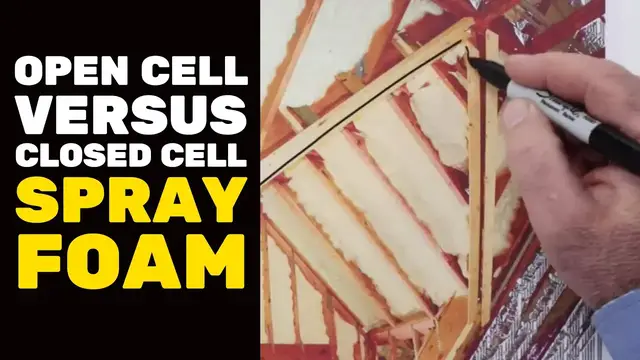
Spray foam insulation like this works very well in a variety of situations
0:06
This one happens to be a cathedral ceiling, so insulation is used to boost energy efficiency
0:14
in the roof and in the walls. But there's something you have to understand, and that's the difference between open-celled
0:20
and closed-cell spray foam insulation. And that's what this video sets out to explain for you
0:28
Real spray foam can be roughly divided into two categories. There's the closed-cell type, which is the most versatile and useful in cold climates
0:38
where heating is required, as opposed to open-cell that I'll be discussing in a few minutes
0:44
As the name suggests, closed-cell is made of a whole bunch of closed cells
0:51
And this matters because it affects how this particular kind of spray foam behaves in the
0:56
real world. When it's applied thickly enough, it can act as its own vapor barrier
1:03
That's a very important and useful quality. Besides the fact that closed-cell foam delivers on average a whopping R6 per inch, and the
1:13
fact that it can block air movement completely, so drafts and air leakage of all kinds, the
1:20
ability to block water vapor is a hidden and really useful feature
1:26
So imagine for a moment you've got a wall structure. The top part of our cross-section is closed-cell spray foam, and the bottom section is more
1:36
conventional fiber-based insulation. This works really well, but it's kind of vulnerable in a way, too
1:44
Let's say it's minus 20 degrees Celsius on the outside of the wall and plus 20 degrees
1:49
Celsius on the inside. This is a pretty typical wintertime situation. Let's imagine for a moment that there is no vapor barrier on the inside, as there normally
1:59
is on a wall of this kind. If indoor air is allowed to pass into the wall because of the absence of the polyethylene
2:06
vapor barrier, it's going to cool, and eventually it's going to condense, and drops of liquid
2:12
water will appear within the wall. This of course is going to lead to mold and rot
2:18
Closed-cell foam acts as its own vapor barrier, so moisture-laden air can't get in the wall
2:24
and condense. Now, if polyethylene plastic is applied to the warm side of a fiber-insulated wall, it
2:31
solves this problem, too. But it's not always possible to apply a vapor barrier like this accurately and completely
2:40
Closed-cell foam also adds a remarkable amount of strength to a structure because it's so
2:46
dense and it adheres so well to framing structures. The other type of spray foam is called open-cell, precisely because the cells that make it up
2:57
are more open. There are a number of advantages to open-cell. It's less expensive, and it uses less resources, but there is a drawback, and this makes it
3:08
less useful than closed-cell in cold and heating climates, although there certainly are uses
3:15
for open-cell, as I'll explain specifically later. Imagine once again that we have spray foam insulation in a wall cavity, except this time
3:25
it's open-cell. This type has a very powerful ability to block air movement, so drafts and winds and things
3:34
can't get through. But what it can't do, no matter how thickly it's applied, is to prevent water vapor from
3:43
entering the wall cavity. So, once again, we've got the hazard of moisture entering a wall cavity, cooling, condensing
3:54
and promoting mold and rot, unless something is done about it, of course
4:00
And that something could be the application of a polyethylene vapor barrier on the inside
4:06
That particular combination works quite well, even with extremes of warm and cold, as you'd
4:12
find during winter. From an insulation point of view, open-cell is significantly less effective per inch than closed-cell
4:21
It'll give you about R3.5 for open, compared with R6 per inch for closed-cell
4:29
But on the plus side, open-cell is cheaper, and it uses significantly fewer resources
4:35
in its manufacturing than closed-cell. If you've spent much time researching the difference between open and closed-cell insulation
4:43
on the internet, you may have discovered something that I have, and that's there's not a whole
4:48
lot of recommended uses for open-cell. So when exactly would you use this stuff
4:55
Well, one place is in a cooling climate, so a climate where you're going to have to cool
5:02
down the inside of your house much more often and much more intensely than heating it
5:07
So once again, let's start with a cross-section of some kind of a framing structure
5:13
This could be a roof or a wall or anything that separates indoor space from outdoor space
5:20
Now let's put some open-cell foam inside this structure. And on the exterior of the structure, let's put on some sort of weatherproof covering
5:31
It's going to shed water, but you can't really rely on it to prevent the movement of water vapor
5:38
So you've got the outdoor side of the structure and the indoor side, and there's a temperature
5:44
gradient between the two, but it's reversed compared with our previous example
5:49
Let's say it's plus 35 C outside and the cooled air-conditioned temperature inside is plus 20
5:57
So what do we have here? Well, if outdoor air is allowed to percolate through this wall, we're going to have the
6:04
potential for some kind of condensation to occur. It's not nearly the potential that would occur in a wintertime structure, but if there is
6:14
any kind of condensation, the beauty of the open-cell is that it allows it to dry
6:19
It doesn't hold that moisture in. And that's one of the reasons why you'd want to use something like this
6:26
A second instance when you might want to use open-cell spray foam is in a vented attic
6:34
situation, even in a heating climate, in fact. So imagine for a moment you have a roof structure like you see here, and it's insulated with
6:44
some open-cell foam on the bottom of the attic, so above the joists that would form the ceiling
6:52
of the interior space. Now as I said, this is open-celled foam, which means it can't stop the passage of water vapor
7:01
but it can dry, and that's kind of one of its pluses. In an application like this, there would be a vapor barrier of some kind on the warm side
7:11
of the insulation. That would be required for this to work properly
7:16
Now in a heating climate, the indoor air would be warm and it would carry moisture to the
7:22
extent that it could cause condensation unless it was deflected, so to speak, by the vapor barrier
7:28
So let's say it's raining, and we have a roof leak, and some moisture gets in
7:34
This is just one of many examples of how moisture can enter a building envelope
7:40
The beauty of open-cell is that it can allow that moisture to escape
7:44
It can dry. It won't hold moisture in anywhere. And that's really one of the main qualities for why you'd want to use it in a particular application
7:54
So to recap, closed-cell spray foam has specific qualities that make it work well in certain situations
8:03
It's most often the foam of choice for cold climates, especially where that cold is extreme
8:12
and the heating expectations are high. Second of all, it's strong and firm, so much so that it can actually increase the strength of a structure
8:24
Closed-cell also does three things well. First, it blocks air movement exceptionally well
8:30
Second, it blocks the passage of water vapor. That's the quality that separates it from open-cell, as long as that closed-cell is
8:38
applied three inches thick or thicker. And of course, closed-cell does deliver exceptional insulation properties as well, about R6 per inch
8:51
Open-cell spray foam is most useful in warm climates where you'll have air-conditioned
8:59
spaces or anywhere where you're not going to have a condensation hazard
9:06
Closed-cell costs less than closed-cell, and it does two things particularly well
9:13
First of all, it blocks air movement, and it delivers insulation at a rate of about R3.5 per inch
Hobbies & Leisure
Home Improvement
HVAC & Climate Control