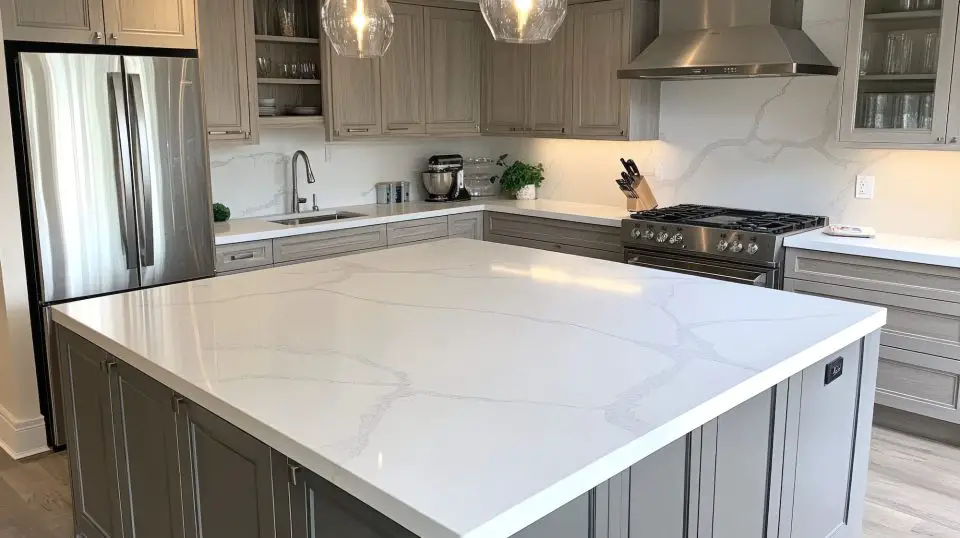
Walk into almost any newly renovated kitchen in Toronto, Vancouver, or Calgary and run your hand along the counter. Odds are good it’s quartz. Not the speckled, slightly plasticky quartz of fifteen years ago, but something that looks remarkably like honed marble or veined limestone, cool to the touch and utterly unbothered by the red wine someone spilled at last weekend’s dinner.
Quartz has quietly become the default countertop for Canadian homes, and yet the material you’d buy today barely resembles what was on offer when it first started displacing granite. Manufacturers keep pushing the technology, the designs, and even the chemistry, and the result is a surface that’s still changing. Here’s how quartz got here, where it’s heading, and what to think about if you’re planning a kitchen.
Still the First Choice, and Pulling Ahead
Designers aren’t shy about their preference. According to the National Kitchen & Bath Association’s 2026 Kitchen Trends Report, 78% of the design professionals surveyed named quartz the number one countertop material, with natural quartzite trailing at 62%.
That dominance isn’t inertia. It reflects a material that has adapted to almost every design shift of the past decade, from the all-white kitchen to the current appetite for warmth, texture, and natural-looking stone.
What Quartz Actually Is
Engineered quartz countertops are made from roughly 90% ground natural quartz crystal bound with polymer resins and pigments, then compressed and cured into slabs. That composition gives it a set of qualities natural stone can’t match on its own:
- Non-porous, so it resists stains without sealing
- Highly consistent from slab to slab
- Hard enough to shrug off everyday knocks and scratches
- Available in colours and patterns that nature never produced
The basic formula hasn’t changed. What has changed is what manufacturers can do with it.
From Flecks to Faithful Stone Looks
Early quartz had a giveaway: a uniform, granular speckle that never quite fooled anyone. That’s gone. Advances in pigment layering, vein-casting, and slab-level design mean today’s quartz can reproduce the soft movement of marble, the dramatic veining of quartzite, and the mottled depth of concrete, often more convincingly than photographs suggest.
Bookmatched slabs, where the pattern mirrors across a seam, are now common in quartz, and full-height backsplashes cut from the same material have become a signature of higher-end kitchens.
Texture Is the New Frontier
For years, polished was the only finish anyone asked for. Now honed, matte, and leathered textures are among the fastest-growing categories. They hide fingerprints, soften glare in bright kitchens, and pair naturally with the warm woods and earthy palettes designers are favouring.
Texture also changes how quartz reads in a room. A matte slab in a soft greige feels closer to natural stone than a glossy white ever did, which is a big part of why quartz has kept pace as tastes moved away from stark, clinical spaces.
Colour Has Moved Beyond White
White and grey still sell, but the palette has broadened considerably:
- Warm neutrals such as taupe, sand, and mushroom
- Deep greens, navies, and charcoals for statement islands
- Subtle terrazzo-inspired patterns for a playful, retro edge
- Soft veining in gold, rust, and bronze rather than only grey
This range lets homeowners use quartz as an accent, not just a safe backdrop.
Who Makes It Matters
Not all quartz is created equal, and the gap between manufacturers has widened as the technology has advanced. Resin quality, pigment stability, slab thickness, and quality control all affect how a countertop looks and performs a decade in. Where the slab is made increasingly matters too, since Canadian-manufactured product avoids the long supply chains and tariff exposure that can affect imported stone.
HanStone is one of the few brands producing quartz slabs in Canada, at its facility in London, Ontario, and it has built its reputation on design-led collections that track closely with what designers are asking for. If you’re weighing brands, it’s worth taking a few minutes to learn more about the company behind HanStone Quartz and how it approaches manufacturing, sustainability, and warranty support. Knowing who stands behind a slab is as important as liking how it looks in the showroom.
Sustainability Is Shaping the Next Generation
The resin in quartz has drawn scrutiny, and manufacturers are responding. Newer formulations use recycled glass and post-industrial content, reduce resin percentages, and rely on lower-emission binders. Some producers have earned third-party certifications for indoor air quality and responsible sourcing.
Health and safety in fabrication have also come under the spotlight, with growing attention to silica dust exposure for workers cutting slabs. Reputable manufacturers are investing in low-silica and silica-free alternatives, which are likely to be the next big shift in the category.
Practical Considerations Before You Buy
Quartz is forgiving, but a few decisions matter:
- Edge profile: simple eased or mitred edges suit modern kitchens; ogee and bullnose lean traditional
- Thickness: 2 cm versus 3 cm affects both look and cost
- Heat: quartz resists heat well but isn’t immune; use trivets under hot pans
- Seams: plan island and long-run layouts with your fabricator to minimise visible joins
- Samples: view large samples in your own kitchen light before committing
A well-planned quartz benchtop balances style, durability, and practicality, helping you create a kitchen that looks great and performs beautifully for years.
Conclusion
Quartz has held its place at the top of the countertop market not because it stopped changing but because it never did. What began as a durable, uniform alternative to granite has evolved into a design material in its own right, with convincing stone looks, tactile finishes, a broad colour range, and a growing focus on sustainability and safety.
For homeowners planning a kitchen, that evolution means more choice and better performance than ever, along with a reason to look closely at who makes the slab and how. The counter you choose today will likely outlast several rounds of trends, so it pays to pick one built to keep looking good through all of them.





I hope you found this content useful!
Your generous support helps me produce more practical, hands-on content that I hope you’ll find useful.
Steve Maxwell