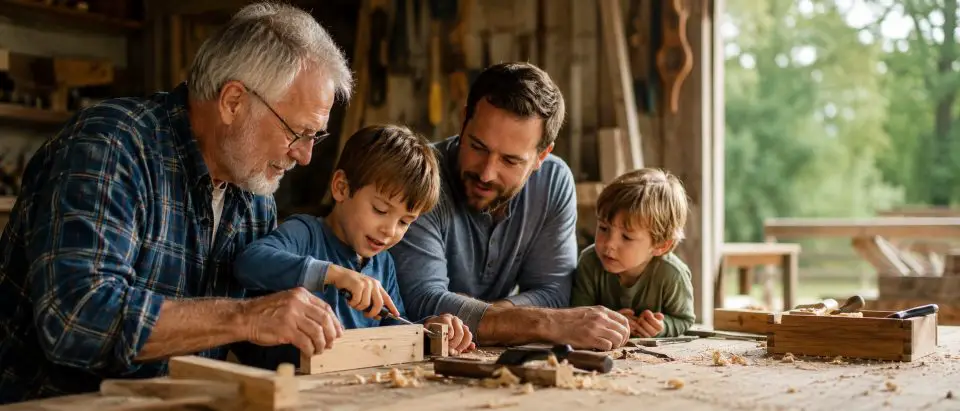
I’ve been around long enough to notice what seems like a serious deterioration in the state of the family, and especially in the amount of meaningful interaction between fathers, grandfathers and children.
In my own case, I’m fortunate enough to live within a mile of all seven of my grandchildren. That gives me a front-row seat to something I’ve come to believe very strongly: kids need fathers and grandfathers who spend real time with them. It can make all the difference in a young and growing life.
What Gets Passed Down
Part of this is practical. Young people need to learn how to use tools, fix things, solve problems, work with their hands and develop confidence in their own abilities. There’s a great deal of practical knowledge that used to pass quite naturally from one generation to the next, but much of that transfer has disappeared.
But practical skills are only part of it.
There are bigger things that fathers and grandfathers can pass along: philosophy, decision-making, wisdom, judgment, faith and worldview. How do you respond when something goes wrong? How do you make a difficult decision when none of the choices are perfect? What does it mean to be steadfast? What does it mean to be honourable? How should you think about work, money, marriage, responsibility, disappointment and success? What should you do when the anxieties of life are taking their toll?
These things don’t get taught in a classroom. In fact, I’m not sure they can be taught at all in a classroom. They’re more often absorbed gradually through conversation, shared work, observation and countless ordinary moments spent together. It’s at least as much about quantity time as quality time.
What Young People Are Missing
My concern is that many young people are missing out on the skills, confidence, perspective and rootedness they’ll need to survive and thrive as adults.
Certainly not all young people. There are excellent families doing excellent things. But I hear enough stories to believe something important has changed.
My own kids tell me stories about friends and acquaintances that reinforce this impression. So many of them are lost and without direction. I’ve also spoken with teachers who’ve been in the classroom long enough to compare young people today with those they taught 30 or 40 years ago. Many of them describe changes that are hard to ignore: less confidence, less resilience, weaker practical abilities and, in some cases, a surprising lack of basic life knowledge.
An Idea for Fathers and Grandfathers
That’s where an idea I’ve been thinking about comes in.
What if there were a group specifically for fathers and grandfathers who want to become more effective at passing useful things on to the next generation?
I’m not thinking primarily about parenting little children. There’s already an enormous amount of material about that. I’m thinking about the much longer role fathers and grandfathers can play as children grow into teenagers and adults, and as grandchildren come along.
The group could be a place for men to share ideas and experiences. What has worked? What hasn’t? How do you remain useful without becoming controlling? How do you build relationships strong enough that children and grandchildren actually want to hear what you have to say?
There could also be practical courses and projects: things fathers and grandfathers can build, repair or learn alongside young people. But I’d want the idea to go beyond projects.
I’d like it to deal with the larger business of living well.
How do we help young people become capable instead of helpless? How do we encourage courage without recklessness, independence without selfishness, confidence without arrogance? How do we model steadiness when circumstances are difficult? How do we pass along standards of honesty, responsibility and honour without turning every conversation into a lecture?
Perhaps most importantly, how do fathers and grandfathers create the kind of relationship where wisdom can actually be received?
I think there’s a genuine need for something like this. What I don’t yet know is whether there are enough fathers and grandfathers who feel that need strongly enough to do something about it.
A few men have already contacted me after I mentioned the idea previously, and I’ll be talking with them more. But I’d very much like to hear from others.
When No Father or Grandfather Is There
There’s another side to this that I don’t want to overlook, but I’m not yet sure how it could be addressed. Many children don’t have an active father or grandfather in their lives at all. If you’re a mother raising children in that situation, I’d especially like to hear from you. What kind of healthy male influence do you wish your children had, and what would genuinely be helpful to your family?
Does this idea resonate with you? If you’re a father or grandfather, what have you found most difficult about remaining meaningfully involved in the lives of younger generations? What has worked especially well? What do you wish you’d understood 20 or 30 years ago?
And perhaps the biggest question of all: do you think there’s enough of a need here that it’s worth building something to address it?
I’d be very interested to hear what you think. Send me an email and we can talk.





I hope you found this content useful!
Your generous support helps me produce more practical, hands-on content that I hope you’ll find useful.
Steve Maxwell