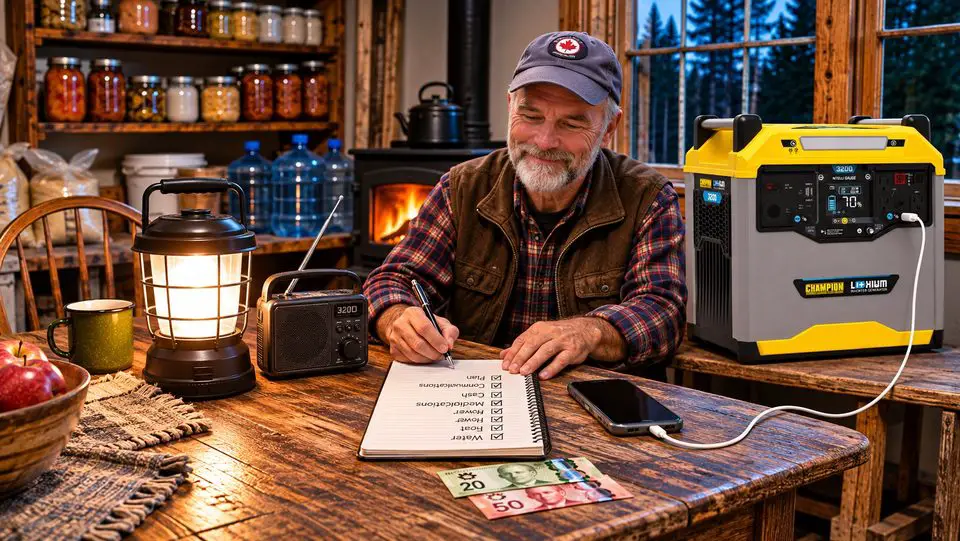
Something unusual is happening around the world, and I think it’s worth paying attention to since it’s entirely to do with home life. Governments are increasingly urging ordinary people to prepare for serious disruptions to everyday routines and supplies. I’m talking about long-term failure of electricity, internet access, banking, communications, water supplies and even the availability of food.
Later in this article, I’ll share some practical resources I’ve developed to help families prepare for longer disruptions, including a 50% discount on two of my practical preparedness courses for readers who want to take action. But first, let’s look at what governments are telling us and why it matters.
What’s Happening?
None of these warnings are coming from survivalists or people who make a habit of predicting catastrophe. It’s coming from governments themselves, and the number of countries delivering this message has increased remarkably in the last year or so. I’ve never seen anything like it.
The latest development happened just this week. On November 3, 2026, the European Commission announced new preparedness guidelines encouraging people to become self-sufficient for at least 72 hours during an emergency. The announcement builds on a broader European preparedness strategy launched in 2025, addressing everything from cyberattacks and sabotage to war, natural disasters and disruptions to essential services. And Europe isn’t alone.
Governments Are Sounding the Alarm
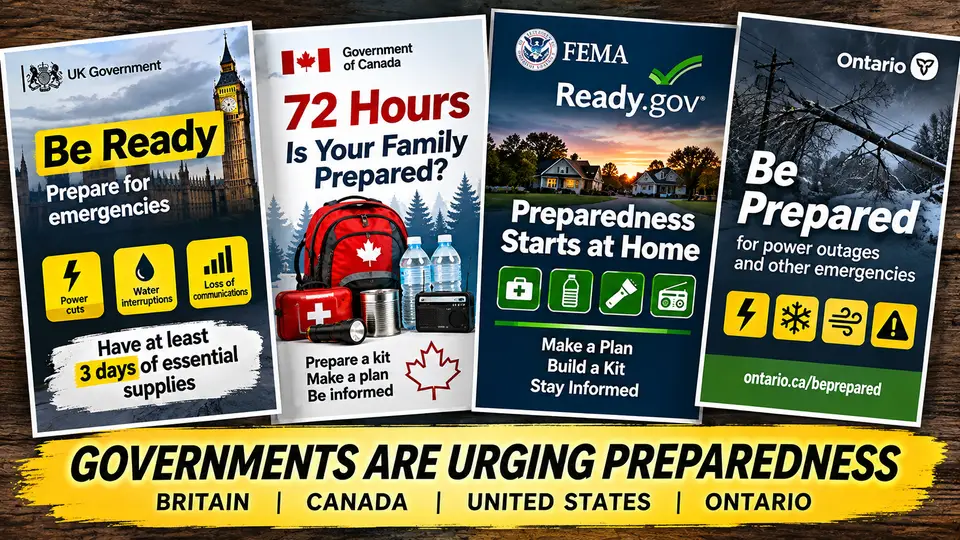
The USA and Canada both recommend emergency kits containing at least 72 hours of supplies. Ontario specifically advises households to keep four litres of water per person per day, along with food, medication, lighting, a radio, cash and other necessities.
On October 22, the British government launched a new three-year public preparedness campaign called Be Ready. The advice includes keeping three days of drinking water and non-perishable food at home, maintaining flashlights and battery-powered radios, and keeping some cash available in case electronic payment systems stop working.
Sweden has gone considerably further. In 2024, the government distributed an updated preparedness booklet to 5.2 million households. Entitled In Case of Crisis or War, it explains how citizens should prepare for circumstances in which electricity, water, communications and ordinary shopping become unavailable. Sweden recommends being able to manage independently for at least one week.
Norway also increased its recommended preparedness period from three days to one week in 2024. Norwegian authorities advise households to store water, food, medications and other essentials, recognizing that emergency services will need to concentrate on people who cannot manage without assistance.
This is quite a collection of warnings, especially when you consider how seldom governments usually talk publicly about the possibility of major disruptions. Something has changed.
But Is Three Days Really Enough?
I’m glad governments are encouraging people to prepare, but there’s something about the 72-hour recommendation that strikes me as inadequate.
Three days is certainly better than nothing. It might be perfectly fine for a localized power outage or a short interruption to municipal water service. But what happens if a major cyberattack disables electrical infrastructure across a large region? What if electronic banking stops functioning, fuel deliveries are interrupted, or grocery stores can’t restock? I know that governments are quietly considering scenarios where electrical blackouts could stretch for months and beyond.
If a disruption is serious enough to affect several essential systems simultaneously, is it reasonable to assume everything will be back to normal in three days? Maybe, sometimes, but I wouldn’t want to count on it.
Remember the phrase two weeks to flatten the curve? The curve didn’t cooperate with the timetable, and the disruption to ordinary life lasted far longer than almost anyone initially expected.
I’m reminded of this whenever I hear officials suggesting three days of preparedness. Of course, the official recommendation is intended as a minimum, not a prediction of how long a crisis would last. Still, three days could be prove too little. Even a week of self-reliance seems highly marginal to me.
Modern Life Is More Fragile Than It Looks
One of the great accomplishments of modern civilization is the extraordinary efficiency with which goods and services reach us. Food arrives at grocery stores almost continuously. Electricity is available at the flick of a switch. Money moves electronically, and information travels around the world instantly. But efficiency and resilience aren’t the same thing. Not at all.
The more interconnected our systems become, the more dependent they are on one another. Without electricity, fuel pumps at gas stations stop working. Without communications, electronic payments become difficult or impossible. Without transportation and functioning distribution centres, grocery store shelves will empty quickly.
You don’t need to believe a catastrophe is imminent to recognize these vulnerabilities. They’re simply part of the world we’ve built.
And while there’s nothing wrong with depending on modern systems when they’re functioning, I think there’s considerable wisdom in retaining the ability to manage when they’re not.
What Can You Actually Do?
My approach to preparedness has always been practical. I don’t think fear is a particularly good foundation for making decisions, and I don’t believe preparing for difficult times requires turning your life upside down.
Start with water. Figure out how much your household needs, store a reasonable supply, and consider how you’d obtain and purify additional water if necessary. Rule of thumb is one gallon per person per day. Here at our place I installed a hand-operated water pump on our well so water storage isn’t that critical.
Next comes food. A well-stocked pantry containing ordinary foods you already eat is a tremendous advantage. Dry beans, rice, grains, canned foods and other long-lasting staples can provide substantial security without costing a fortune.
Think about cooking, too. A supply of food isn’t much use if you have no way to prepare it. The same goes for keeping warm, providing light, maintaining communications and handling basic sanitation.
And don’t overlook practical skills. Knowing how to grow food, preserve a harvest, maintain equipment and solve problems without outside assistance can be more valuable than any collection of emergency supplies.
Feed Yourself for a Year (or just weeks)

All this is why I created my course Feed Yourself for a Year. It takes preparedness beyond a few days of stored food and explores how ordinary people can develop a much greater degree of food independence. Use the coupon code “HALF-OFF” at check out (no quotation marks) to get this weekend’s special price.
The goal isn’t necessarily to produce every morsel of food your family eats. It’s to understand what’s possible, develop useful skills and put systems in place that make you much less vulnerable to disruptions beyond your control.

I’ve also assembled a Preparedness Bundle of Courses, bringing together six practical courses (including Feed Yourself for a Year) into a discounted bundle for people who want to become more capable and self-reliant in several important areas. Use the code “HALF-OFF” at checkout (no quotation marks) to get this weekend’s special price.
These resources are about learning to do things that people routinely knew how to do just a few generations ago. Both the course and the bundle are available to anyone in my supporter group as part of membership.
And there’s something else worth considering. The skills and systems that help during an emergency are often valuable even when everything is going well. Growing food, preserving it, working with your hands and becoming more self-reliant can make ordinary life richer and more satisfying even during normal times.
Governments around the world are now telling their citizens to prepare for the possibility that modern systems won’t always be there when needed. I think that’s sensible advice. My only addition would be this: Why stop at three days when you can work toward being prepared for much longer? That’s a goal worth pursuing, whether a major disruption ever comes or not.





I hope you found this content useful!
Your generous support helps me produce more practical, hands-on content that I hope you’ll find useful.
Steve Maxwell