- Video Watch Time = 4 minutes
Key Takeaways
- A MIG welder can work on a regular 110 volt outlet.
- 110 volt MIG welders are best for lighter-duty welding jobs.
- Practical welding thickness on 110 volts is about 1/8 inch.
- 220 volts is better for welding thicker steel, up to about 1/2 inch.
- Dual-voltage MIG welders offer useful flexibility in a home workshop.
Can a MIG welder work from a regular 110 volt outlet? If your shop only has standard household power, the good news is yes. In my experience a 110 volt MIG welder can handle many light welding jobs around a home workshop, though there are important limits on metal thickness and overall output. If you understand those limits, a small 110 volt welder can be a practical, portable and affordable way to get started.
Can a MIG Welder Work on 110 Volts?
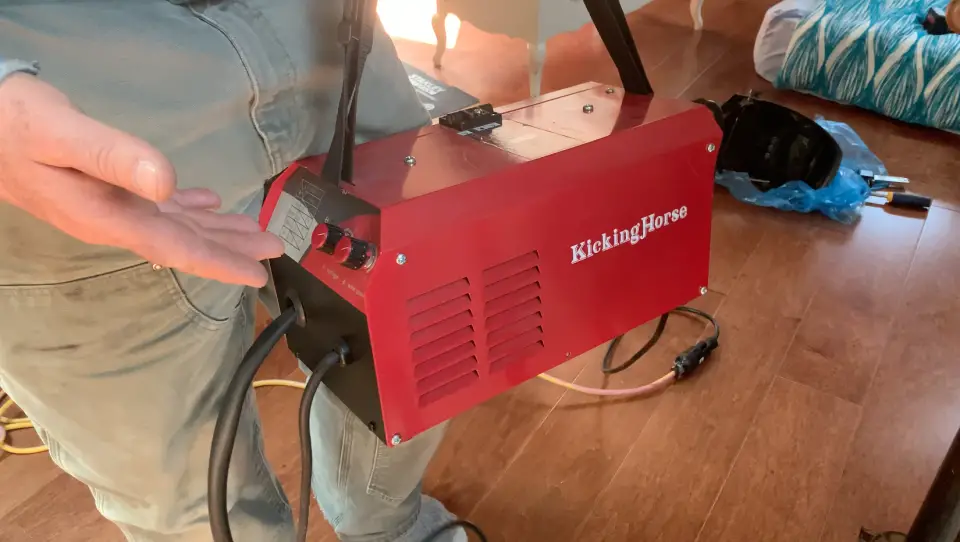
Yes, a MIG welder can work on a regular 110 volt outlet, and this is one of the reasons small welders have become so popular with homeowners and hobbyists. There are now many compact machines on the market that plug into an ordinary household receptacle and still deliver useful welding performance.
Yes, but there are limits
The biggest limitation with 110 volt MIG welding is output. These machines can do real work, but they cannot handle the same thickness of steel as a full 220 volt welder. That does not make them a bad choice. It simply means they are better suited to lighter-duty tasks.
Why 110 volt MIG welders are popular
A 110 volt welder is attractive because it is affordable, portable, and easy to use anywhere normal household power is available. That lowers the barrier to entry for people who want to learn welding without rewiring a shop first.
What a 110 Volt MIG Welder Can Really Do
For many homeowners, farm repairs, brackets, small fabrication jobs, and light-duty steel work are exactly the kind of projects that matter most. A 110 volt MIG welder can often handle these jobs very well.
Best for light-duty welding jobs
If your work involves thinner material, smaller repairs, or occasional fabrication, a 110 volt machine may be all you need. It offers enough performance for many practical workshop tasks while remaining easy to move and store.
Maximum practical thickness is about 1/8 inch
Operting on 110 volt power limits MIG welding to about 1/8 inch maximum metal thickness. That is enough for a surprising number of common repair and fabrication tasks, but it is not ideal for heavier sections of steel.
When 220 Volts Makes More Sense
There comes a point where more power is simply the better tool for the job.
Thicker metal needs more power
If you expect to weld thicker steel regularly, 220 volts is the better choice. The live article notes that stepping up to 220 volts allows welding of metal up to about 1/2 inch thick.
Why dual-voltage welders are useful
One especially useful option is a dual-voltage machine. The article mentions the Lincoln 210MP as an example of a welder that can run on either 110 or 220 volts using different cords. This kind of flexibility is ideal for people who want portability now and higher output later.
Choosing the Right MIG Welder for a Home Shop
The best welder is not necessarily the biggest one. It is the one that fits your power supply, your budget, and the type of work you actually plan to do.
Portable 110 volt welders are affordable and convenient
Small 110 volt welders are often the most economical option, and they can go places larger machines cannot. That makes them especially useful for home shops, occasional outdoor repairs, and mobile work.
Match the welder to the kind of projects you do
If most of your jobs involve light steel and household repairs, 110 volts may be plenty. If you plan to weld thicker steel often, it is worth considering 220 volts or a dual-voltage welder instead.
Frequently Asked Questions
Can a MIG welder run on a regular household outlet?
Yes. A 110 volt MIG welder can run on a regular household outlet, which is one reason these machines are popular with homeowners.
Is a 110 volt MIG welder powerful enough?
Yes, for light-duty work. A 110 volt MIG welder can handle many useful repair and fabrication jobs, but it has limits compared with 220 volt machines.
What thickness of steel can a 110 volt MIG welder weld?
The article gives a practical maximum of about 1/8 inch thick steel on 110 volts.
What thickness can a 220 volt MIG welder handle?
The article says 220 volts can handle metal up to about 1/2 inch thick.
Is a dual-voltage MIG welder worth it?
A dual-voltage MIG welder can be a very good choice because it offers the convenience of 110 volt operation and the higher output of 220 volts when needed.
Should I install a 220 volt outlet for MIG welding?
If you only do lighter work, 110 volts may be enough. If you plan to weld thicker steel regularly, installing 220 volts can make sense.
Learn to Weld Online
If you know nothing about welding but have an interest in learning how, take a look at my online course. Hundreds of people have taken it and are getting great results building and fixing things made of steel. As with all my courses, there’s a money-back guarantee that eliminates all risk for you.
Want more practical home improvement ideas like this?
Join the Bailey Line Road newsletter for weekly DIY tips, building advice and real-world solutions for homeowners.





I hope you found this content useful!
Your generous support helps me produce more practical, hands-on content that I hope you’ll find useful.
Steve Maxwell