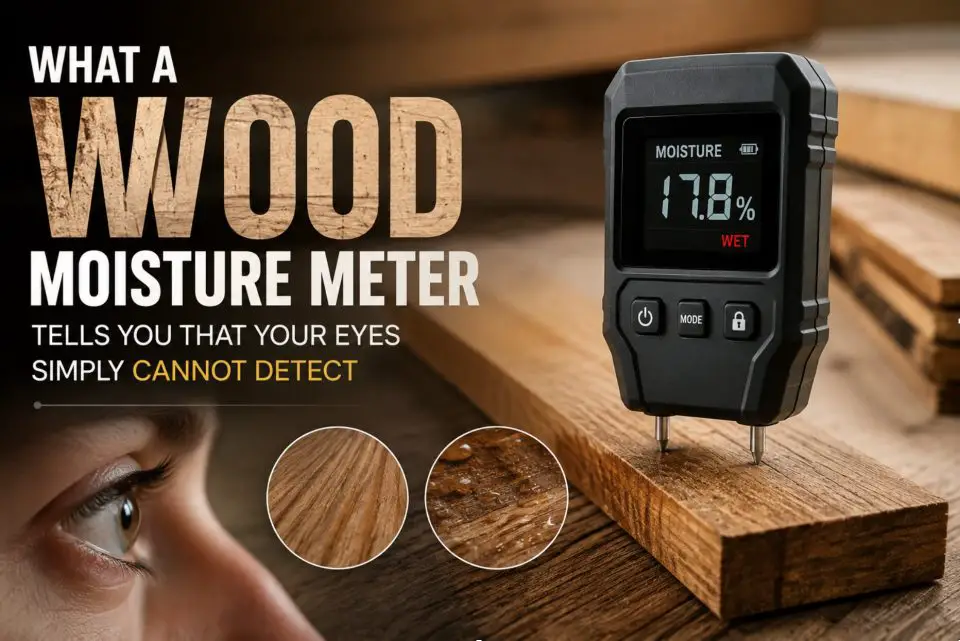
Have you ever picked up a piece of lumber, run your hand over it, and declared it dry, only to watch it warp or gap weeks after you built something with it? Wood has a way of looking and feeling perfectly stable while hiding exactly the kind of internal moisture that ruins a project after the fact. That gap between appearance and actual moisture content is where a huge share of flooring failures, furniture defects, and framing problems quietly begin.
The eye is simply not equipped to detect what is happening inside a piece of wood. A moisture meter is the only reliable way to know, and understanding why makes it obvious why skipping this step causes so many avoidable problems.
Why Wood Can Look Dry and Still Be Far From Ready
Wood absorbs and releases moisture constantly in response to its surrounding environment, a property that never fully stops even once a board looks finished and stable. Two pieces of the same species, cut from the same batch, can carry meaningfully different moisture levels depending on how and where they were stored, and neither will show any visible sign of that difference.
This becomes a real problem the moment that wood gets installed or built into something permanent. A board that feels dry to the touch can still be well outside the acceptable range for its intended use, and by the time visible symptoms appear, cupping, gapping, splitting, the wood has often already been installed or finished.
What Does a Moisture Meter Actually Reveal?
A wood moisture meter measures something your senses cannot access at all: the actual percentage of water content inside the wood, expressed as a precise number rather than a guess.
- The true internal moisture percentage. A meter gives an exact reading rather than a subjective impression, removing the guesswork that leads to installing wood too wet or too dry for its environment.
- Whether wood matches its destination environment. Different climates and interior conditions require different target moisture ranges, and a meter confirms whether a specific board is actually acclimated to where it is going.
- Whether flooring and subfloor are properly matched. Installation failures often trace back to a mismatch between the moisture level of the flooring and the subfloor beneath it, something invisible without direct measurement.
- Species-specific accuracy. Most meters are calibrated to a reference species, and correcting for the actual wood being tested, oak, walnut, pine, and so on, prevents readings that look fine but are actually off by several points.
- Problems before they become permanent. Catching an elevated reading before installation, milling, or finishing allows correction before the wood is locked into a project where fixing the issue becomes far more expensive.
Taken together, these are exactly the details a visual inspection can never provide, which is precisely why a meter, not judgment, is what actually protects a project.
Choosing a Meter Built for the Job
Reliable results depend on using a wood moisture meter with the correct species correction and measurement method for the specific job, since a meter calibrated only for a single reference species can produce readings that look confident but are meaningfully off for denser hardwoods.
SensoraHome is one supplier whose wood moisture meter lineup specifically distinguishes between species and applications, from flooring and furniture stock to firewood and framing lumber, rather than treating every type of wood the same way.
What the Wood Flooring Industry’s Own Standards Confirm
This is not a minor technical detail left to individual judgment. According to the National Wood Flooring Association’s Installation Guidelines, installers should never install a wood floor over a known moisture condition, and it is considered compulsory practice to test for moisture regardless of visible conditions so that any unknown issues become known ones that can be addressed. The guidelines specifically call for testing wood flooring, wood subfloors, and the surrounding jobsite conditions before installation, with the flooring generally required to stay within 2 to 4 percentage points of the subfloor’s moisture content depending on board width.
That level of specificity reflects just how much these numbers matter to long-term performance, and it is guidance that simply cannot be followed without a properly calibrated meter in hand.
Where This Matters Most in Practice
Moisture testing is not just a flooring concern. It shows up across nearly every stage of working with wood, each with its own risk if skipped.
Flooring Installation
Hardwood and engineered flooring installed outside the correct moisture range are prone to cupping, gapping, or buckling within the first heating or cooling season, often voiding manufacturer warranties in the process.
Furniture and Woodworking
Furniture-grade lumber that is milled or joined before reaching a stable moisture level tends to move after the fact, warping joints and finishes that look perfectly fine on the workbench.
Framing and Structural Lumber
Framing lumber installed too wet can shrink significantly as it dries in place, leading to squeaky floors, nail pops, and drywall cracking months after construction wraps up.
Firewood
Wood burned above roughly 20 percent moisture content burns inefficiently, produces more creosote buildup, and generates far less usable heat than properly seasoned wood.
One Measurement, Many Applications
Flooring, furniture, framing, and firewood may seem like completely different applications, but they all depend on the same fundamental question: is the wood at the right moisture level for its intended use?
A moisture meter provides a clear, objective answer, while relying on appearance, touch, or experience alone leaves each application vulnerable to hidden moisture problems that can affect performance, durability, and long-term results.
Final Thoughts
Wood moisture problems are almost entirely invisible until the damage has already happened, which is exactly why relying on touch, appearance, or experience alone leaves so much room for costly mistakes. A proper moisture meter closes that gap by giving an actual number instead of a guess, confirming whether wood is genuinely ready for installation, milling, or burning rather than simply looking the part.
The industry’s own installation standards make clear that testing is not optional, and for anyone working with wood in any serious capacity, a reliable meter is the difference between a project that performs the way it is supposed to and one that quietly fails months down the line.





I hope you found this content useful!
Your generous support helps me produce more practical, hands-on content that I hope you’ll find useful.
Steve Maxwell