Most Philadelphia drivers only think about the little sticker in the corner of the windshield when a friend points out that it expired two months ago. By then the clock has already run out, and police can cite you for driving on it. Knowing what the inspector actually checks makes the trip to a certified station shorter, and usually a lot cheaper.
Here is the short version. In Philadelphia and the four collar counties of Bucks, Chester, Delaware and Montgomery, an annual state vehicle inspection bundles two separate tests into one visit: a safety check of the parts that stop, steer and light up your car, and an emissions check that reads its onboard computer. Pass both and the new stickers go on the glass before you leave, while a failure on either one sends you home with a repair list.
Below is what each test covers, the problems that keep local cars from getting a sticker, what the bill tends to look like, and what to do when a car doesn’t make the cut.
Two Tests Behind One Sticker
Pennsylvania requires a safety inspection every year for passenger cars statewide. Emissions testing applies only in part of the state. PennDOT runs it in 25 of the state’s 67 counties, and all five counties of the Philadelphia region are on that list. A driver in Fishtown and a driver in Doylestown go through the same two-part routine, while a cousin up in Potter County only gets the safety half.
The emissions program covers gasoline cars, vans and light-duty trucks from model year 1975 onward. Diesel vehicles are exempt under federal rules, and Pennsylvania also leaves out motorcycles. Cars registered as classic, antique or collectible skip the test too.
What the Safety Inspection Looks At
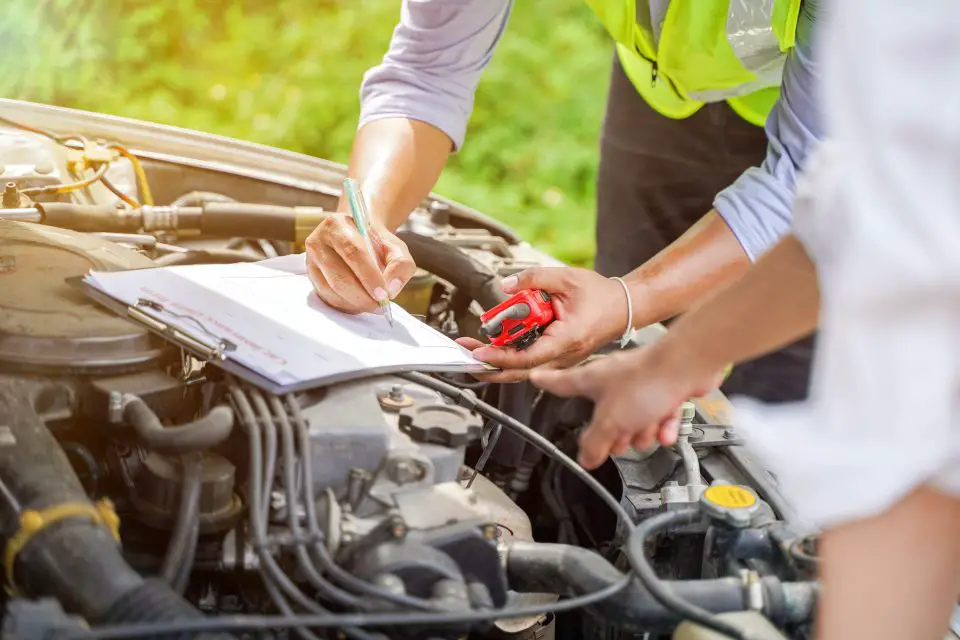
The safety half is the hands-on part. A certified inspection mechanic puts the car on a lift, walks around it with a flashlight and works through a state checklist. Each item gets a pass or a fail, with no partial credit.
- Brakes, including pads, rotors, lines and the parking brake
- Tires, with tread depth measured against the 2/32-inch minimum
- Headlights, brake lights, turn signals and reverse lights
- Windshield condition, wiper blades and washers
- Steering and suspension parts, checked for play and wear
- Horn, mirrors and seat belts
- Exhaust leaks and loose hangers
Honestly, most of this list is stuff you can eyeball in your own driveway or on the curb outside your rowhouse. Walk around the car while someone presses the brake pedal and works the turn signals, and you’ll catch the cheapest failures before a mechanic does. A coin in the tire grooves gives you a rough read on tread, and a quick spray of washer fluid tells you whether the wipers streak.
The Emissions Check in the Five-County Region
For cars built in 1996 or later, the emissions test is mostly a conversation with the car’s computer. Since April 2004, stations in the Philadelphia region have plugged a scanner into the onboard diagnostics port, the same connector under the dashboard that shop technicians use to read trouble codes. The scanner looks for stored faults and checks whether the car’s self-tests, called readiness monitors, have finished running. A gas cap test rounds it out, since a cap that doesn’t seal lets fuel vapor escape into the air.
Two exemptions come up often. A brand-new car that was never titled before and has fewer than 5,000 miles at registration gets an exemption sticker good for up to 12 months. An older car driven fewer than 5,000 miles in the year before inspection can also qualify, though only a certified emissions inspector can verify the mileage and issue that sticker. Either way, the safety inspection still has to happen.
Why Cars Fail
Most cars pass, which is worth remembering if you’re dreading the appointment. Between 2011 and 2017, Pennsylvania tested an average of 5.7 million vehicles a year for emissions, and fewer than 4 percent failed, according to figures published by the chair of the state Senate Transportation Committee. Among vehicles eight years old or newer, the failure rate was about 2 percent.
When an emissions test does go wrong, a lit check engine light is the usual culprit. If it’s glowing when you pull in, the diagnostic scan finds the stored code and the car fails before anyone looks further. The underlying fault has to be fixed first, whether it’s a worn oxygen sensor, a cracked vacuum hose or an ignition coil that misfires.
A sneakier failure shows up as a “not ready” result. This happens when the computer’s memory was recently wiped, usually by a dead or replaced battery, or by someone clearing codes with a cheap scanner to make the dashboard light disappear. The readiness monitors need several days of mixed city and highway driving to complete. PennDOT treats a not-ready car as unable to pass, and the station can still charge for the test. If you swapped a battery last week, give the car a few commutes on I-95 or the Schuylkill before booking.
On the safety side, the frequent failures tend to be the inexpensive ones: a dead license plate bulb, a cracked brake light lens, wipers that leave streaks, or tires worn past the tread limit. Philadelphia’s potholes add their own entries, from torn ball joint boots to loose tie rod ends that show up as play in the steering.
What the Inspection Costs
Part of the price is fixed by the state and part is set by each shop. PennDOT raised the annual safety sticker from $11 to $12 on July 1, 2025, and the emissions sticker carries no state fee at all. The labor for performing the inspection is up to the individual station, which is why prices differ from one block to the next. Official stations post their inspection fees for customers to see.
| Cost item | Who sets it | What to expect |
| Annual safety inspection sticker | PennDOT | $12 statewide since July 1, 2025 |
| Emissions inspection sticker | PennDOT | No state fee |
| Safety inspection labor | Each station | Posted at the station, varies by shop |
| Emissions test | Each station | Around $40, per figures cited by state senators |
| Emissions retest within 30 days | PennDOT rule | Free at the station that ran the first test |
| Repairs needed to pass | Each shop | Depends entirely on what failed |
Most of the money goes into that last row. Asking for a written estimate before any work starts protects you from surprises, and some drivers book a quick pre-inspection look a week ahead so they have a few days to compare repair quotes before the official test.
If Your Car Fails
A failed inspection comes with a written list of what needs fixing, and you decide where the work gets done. For emissions, PennDOT lets you return to the same station for a free retest within 30 calendar days. Go to a different shop, or wait longer, and you pay for a fresh test.
Having the inspecting shop handle the repairs often saves a step, because the mechanic who found the problem already knows exactly what failed and can recheck it right away. Ask how the shop handles the safety re-check as well, since stations set their own policies on that part.
If an older car keeps failing emissions after legitimate repair attempts, Pennsylvania offers a repair waiver. It comes with spending and paperwork requirements, so ask the station about it before you write the car off.
Timing Your Visit
Pennsylvania lets you get inspected up to 90 days before your sticker’s month ends, and the new sticker keeps your existing expiration month. Going early costs nothing and buys time to fix whatever fails. The last week of the month is when shops get slammed, because that’s when every procrastinator in the Delaware Valley suddenly notices the windshield.
Bring your current registration card and proof of insurance. The inspector needs to see both before any stickers go on the car.
Is the Emissions Test Going Away?
Harrisburg has argued about this for years. Senate Bill 149, sponsored by Sen. Wayne Langerholc, would exempt vehicles from emissions testing during their five most recent model years, and PennDOT estimated that about 2.1 million vehicles would qualify. The Senate approved it in 2025 and sent it to the House. New Jersey, Delaware, Connecticut, Rhode Island and Virginia already run similar exemptions with federal approval.
Even if a version becomes law, the yearly safety inspection would stay, and cars older than five model years in the five-county region would keep doing both tests. For a Philadelphia driver with a 2015 sedan, the routine at the inspection lane stays exactly the same next year, which makes a ten-minute walk-around of bulbs, wipers and tires the week before the appointment the cheapest insurance against a second trip.



I hope you found this content useful!
Your generous support helps me produce more practical, hands-on content that I hope you’ll find useful.
Steve Maxwell