Key Takeaways
- The email’s dramatic claims about wooden cutting boards are not backed up with clear, traceable studies.
- USDA allows both wood and plastic boards and says both can be sanitized.
- Peer-reviewed studies have found lower recoverable bacterial counts on wood than on plastic under test conditions.
- Plastic boards can release microplastics, but the health implications are still being worked out and should not be overstated.
- Deep grooves are a problem on any cutting board material. Replace boards that become badly worn.
- The biggest food-safety wins come from separating raw and ready-to-eat foods, washing promptly, sanitizing when needed, and drying thoroughly.
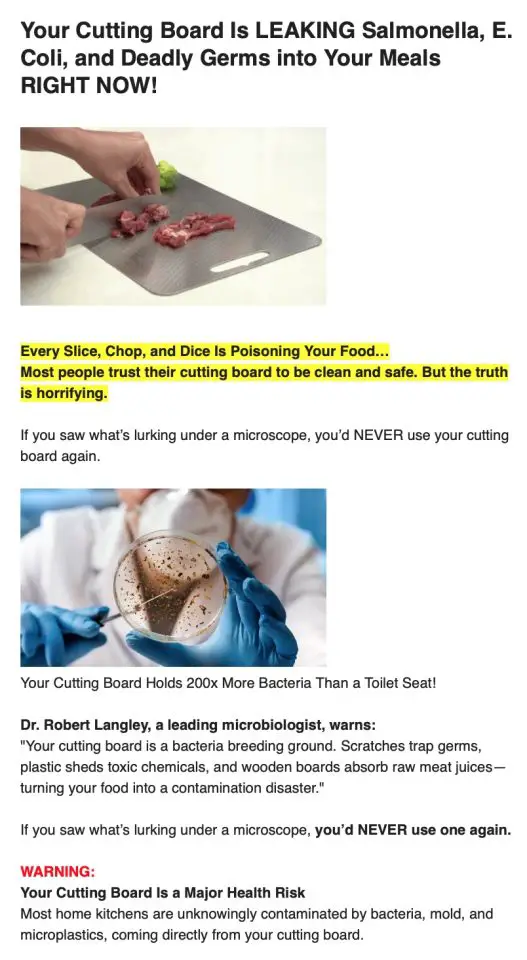
A marketing email making the rounds lately claims that wooden cutting boards are “a bacteria and mold nightmare,” that they raise food-poisoning risk by “up to 200%,” and that a stainless-steel alternative solves the problem. That’s the email ad above and perhaps you’ve seen it. It delivers powerful sales copywriting, but it’s not an honest summary of the evidence at all. The email offers dramatic warnings, but no traceable studies for its biggest claims, plus plenty of claims that are simply not true.
The practical question for homeowners is simple: Are wooden cutting boards actually unsafe, as the ad claims so loudly?
The answer from food-safety guidance and peer-reviewed research is no. Wood is not automatically dangerous, and in some published studies it has performed better than plastic in limiting recoverable bacteria on the surface. The bigger issue is not whether a board is wood, plastic, or steel. It is whether it is used properly, cleaned properly, dried properly, and kept out of cross-contamination trouble.
Key Takeaways
- The email ad’s biggest claims about wood are not backed up with identifiable studies.
- USDA guidance allows both wooden and plastic cutting boards and says both can be sanitized.
- A classic peer-reviewed study found fewer bacteria were generally recovered from wood than plastic after contamination.
- A 2025 study found sugar maple cutting boards reduced detectable E. coli to the detection limit after just two hours, while HDPE plastic showed higher microbe detection overall.
- Plastic boards can shed microplastics too, and that’s a growing concern.
- Deeply worn boards of any material can become harder to clean and should be replaced.
Wood Is Not a “Disease Vector” by Default
The email’s central message is that wooden boards absorb meat juices, hide dangerous bacteria, and keep contaminating food over and over. That simply is not true. In the classic 1994 study by Ak and Cliver, fewer bacteria were recovered from wooden blocks than from plastic blocks, and the authors reported that clean wood rapidly absorbed the inoculum, after which the bacteria were less recoverable from the surface.
That result has not simply disappeared with time. A 2025 study in the Journal of Food Protection compared sugar maple with HDPE plastic and found that maple boards showed a significant reduction in detectable E. coli to the detection limit after two hours, even without cleaning, while HDPE boards showed higher detection rates overall. The authors concluded that wood’s hygiene status in food preparation deserves reevaluation.
This does not mean wood is magic. It means the broad marketing claim that wood is inherently a bacterial disaster is not supported by the published evidence.
Claim-by-Claim: What the Email Gets Wrong
“Wooden boards increase the risk of food poisoning by up to 200%”
This claim appears in the email, but the email provides no study, journal citation, author, institution, or even enough information to verify where the number came from. In contrast, USDA food-safety guidance says consumers may use wood or a nonporous surface for cutting raw meat and poultry, and USDA also says both wooden and plastic cutting boards can be sanitized with a bleach solution. That is not what you would expect if wood really raised food-poisoning risk by 200%.
“Wood absorbs raw meat juices, creating the perfect home for E. coli and Salmonella”
Wood does absorb moisture, but “absorbs moisture” is not the same thing as “becomes a permanent bacterial reservoir.” The Ak and Cliver study found that on clean wooden boards, the contaminated liquid was absorbed and bacteria became much less recoverable from the surface, while new plastic allowed bacteria to persist more readily on the surface. The more recent 2025 maple-vs-HDPE study also found lower detectable bacterial counts on maple than HDPE. Why? Perhaps it’s because wood is a very porous surface, leaving the bacteria high, dry and dead.
For a homeowner, the practical message is this: a well-made hardwood board that ‘s cleaned and dried properly is not a contamination disaster at all.
“Deep cracks trap bacteria—even after scrubbing”
This part is only partly true, and it is not unique to wood. Food-safety guidance warns that excessively worn wooden or plastic cutting boards should be discarded because deep grooves are harder to clean. North Carolina State Extension similarly notes that a knife-scarred plastic board can become as difficult to clean as a wooden one. So the real issue here is condition, not just material.
A board with deep, damaged grooves is a board nearing the end of its useful life, whether it is wood or plastic.
“Mold and fungus grow inside wooden boards, contaminating every meal”
Wood can develop mold if it is stored wet, left dirty, or abused. But that’s a maintenance failure, not proof that wood is unsuitable. Extension guidance on wooden boards emphasizes routine washing, prompt drying, and avoiding prolonged soaking because excessive moisture can warp or crack the wood over time. That’s the practical way to keep a wooden board healthy in use. In other words, a dry, well-cared-for hardwood board is a very different thing from a neglected board left damp in a sink.
What the Email Gets Right About Plastic — and What It Overstates
The strongest factual point in the email is that plastic cutting boards can shed microplastics. A 2023 study in Environmental Science & Technology identified plastic chopping boards as a substantial source of microplastics in food, and a 2025 systematic review also found consistent laboratory evidence that plastic cutting boards can release microplastics during use.
But the email then jumps from that real concern to sweeping health claims about memory loss, infertility, organ damage, and permanent harm as though those outcomes were already proven at the household-cutting-board level. That’s too strong. A recent review on microplastics and health says current evidence does not permit definitive conclusions about health effects in humans, and Health Canada says more research is needed to understand exposure and toxicological hazards.
So the balanced conclusion is this: plastic boards do appear to be a real source of microplastic exposure, but the health-risk story is still evolving and should not be exaggerated.
The Stainless-Steel Sales Pitch Has Problems Too
The email’s proposed solution is a stainless-steel board marketed as non-porous, bacteria-proof, scratch-proof, dishwasher-safe, and “knife-friendly.” The problem is that the email gives no real evidence for these sweeping claims. It offers a branded surface name, a quoted expert with no traceable published evidence in the ad, and a list of benefits that sounds more like ad copy than technical evaluation.
The “knife-friendly” claim is especially doubtful. Extension guidance routinely describes hardwoods like maple and beech as gentle on knife edges, while harder surfaces such as bamboo can dull knives faster than softer wood or plastic. That doesn’t prove a given stainless-steel board will always be terrible, but it does make the promise of a metal cutting surface that is somehow easier on knives than wood highly suspect unless the manufacturer can provide serious independent testing. Besides, do you really want to move a carefully sharpened knife back and forth over metal?
The email is also contradictory in spirit. It attacks plastic for scratching, then claims a “scratch-proof” cutting surface is a benefit. But some degree of surface give is exactly what helps protect knife edges. A board that never marks at all is not automatically a better cutting surface. If you’re not scratching the surface with your knife, your knife edge is taking some serious abuse.
What Food-Safety Agencies Actually Recommend
Food-safety agencies focus far more on use and cleaning practices than on a simplistic “wood bad, steel good” message. CDC recommends washing cutting boards, utensils, and countertops with hot, soapy water after preparing each food item and stresses separation between raw meat and ready-to-eat meats. USDA says both wood and plastic boards can be sanitized with a dilute bleach solution. Health Canada likewise emphasizes keeping cutting boards separate for raw foods and washing utensils used with raw food before reuse.
This is the practical core of cutting-board safety:
- use one board for raw meat and another for foods that will not be cooked again
- wash promptly with hot, soapy water
- sanitize when needed
- dry thoroughly
- replace boards that become deeply scarred or damaged
So What Should a Homeowner Actually Use?
For most homeowners, a good hardwood cutting board remains a practical, safe choice for everyday kitchen use. The evidence doesn’t support the idea that wood is inherently unsanitary. In fact, published studies suggest hardwood can compare very well with plastic, and sometimes better, when bacterial survival on the surface is measured.
Plastic still has a place, especially if you want a dedicated raw-meat board that can go through more aggressive sanitizing cycles. But the smart homeowner takeaway is not “throw out all your wood boards.” It is “use the right board for the right job, keep it clean, and replace it when it wears out.” If you value practicality and technical soundness, the email’s fear-based message should not move you off wood. A well-made maple or similar hardwood board, used with good kitchen hygiene, is still one of the best cutting surfaces you can own.
Frequently Asked Questions
Are wooden cutting boards safe for raw meat?
Yes, they can be, provided they are cleaned properly afterward. USDA guidance allows wood or nonporous surfaces for cutting raw meat and poultry, and emphasizes cleaning and sanitizing after use.
Do wooden cutting boards harbor more bacteria than plastic?
Not necessarily. Classic research found fewer bacteria were generally recovered from wood than plastic, and a 2025 study found lower detectable E. coli counts on maple than HDPE plastic.
Can plastic cutting boards shed microplastics?
Yes. That concern is supported by recent research. But the exact health risk from household cutting-board exposure is still being clarified.
Should I throw out my wooden cutting board if it has knife marks?
Not automatically. Normal wear is expected. But if the board becomes deeply scarred, cracked, or hard to clean, it should be replaced. That advice applies to wood and plastic alike.
What is the safest practical setup for a home kitchen?
Use separate boards for raw meat and ready-to-eat foods, wash with hot soapy water after each use, sanitize when needed, and dry thoroughly. Material matters less than disciplined food-handling habits.
Suggested meta title
Are Wooden Cutting Boards Safe? Science vs Marketing Hype
Suggested meta description
A practical, evidence-based look at whether wooden cutting boards are really unsafe. See what studies say about bacteria, mold, microplastics, knife wear, and safe kitchen use.





I hope you found this content useful!
Your generous support helps me produce more practical, hands-on content that I hope you’ll find useful.
Steve Maxwell