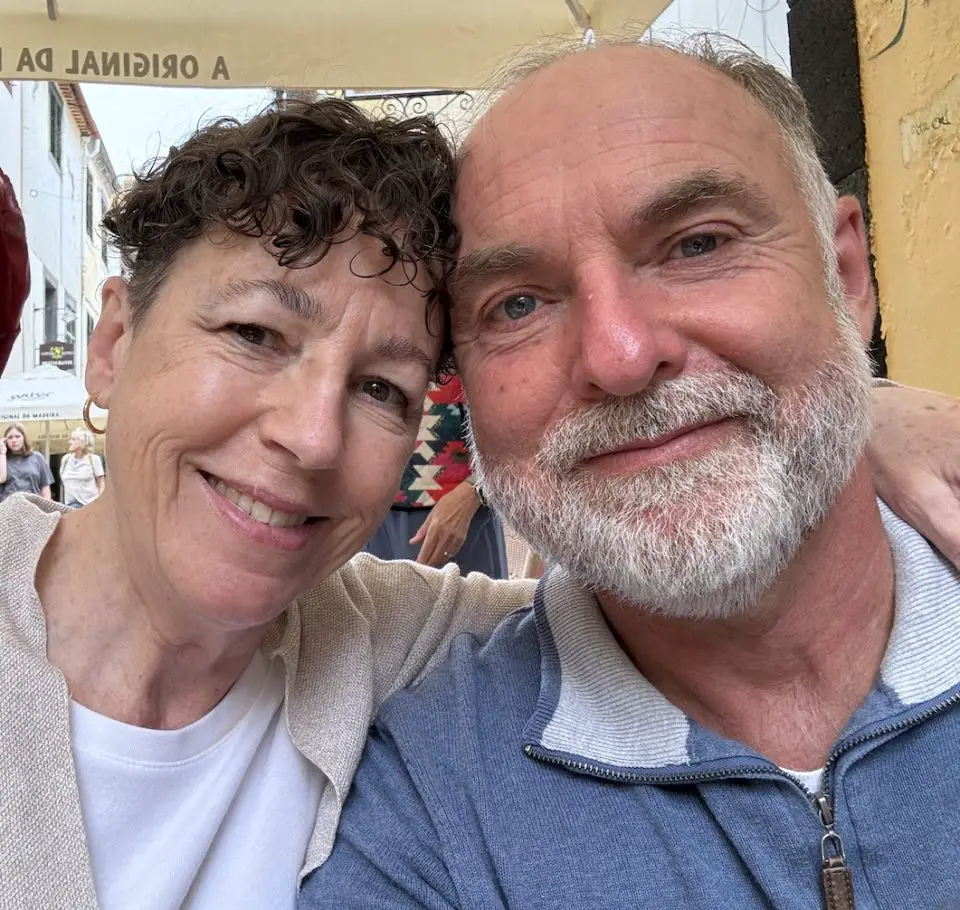
As some of you may remember, in May 2024, my wife, Mary, was diagnosed with a rare and advanced spinal cancer called chordoma. Literally only one person in a million gets diagnosed with this each year. And looking back on our time wrestling with this challenge, some things have occurred to me that I think you might find helpful if you or a loved one finds themselves in the cancer world.
Dealing With the Fear
Mary had been experiencing excruciating neck pain for 18 months. X-rays were taken, the radiologist said everything looked fine structurally, so the issue must be muscular. That was back in late 2022. Physiotherapy was recommended and Mary got it. When some difficulty swallowing also showed up in early May 2024, Mary got a CAT scan. Two weeks later, we got a phone call from our local doctor’s office at 9am.
“You absolutely must come in to see the doctor today at 2pm and be sure Steve is with you.”
This kind of thing is never good news, especially from a medical clinic where it normally takes weeks to get an appointment.
“Your second vertebrae from the top, called C2, is mostly gone,” the doctor explained, “and there’s a big growth in the area. We don’t know what it is yet, but your neck could break at any moment. You must wear a neck brace all the time and be very careful. One jolt could kill you. I’ll refer you to specialists in Sudbury, Ontario. If you haven’t heard back from them in 5 weeks, let me know.”
Five weeks is an awfully long time indeed when your neck could break at any moment. But sad to say long wait times have become quite common in Canada. Our system used to work well all the time, and still works amazingly well in some situations. But I can’t avoid the conclusion that the wheels are falling off in too many cases when it comes to wait time and getting rushed out of hospital.
At this stage of the cancer journey, fear rules. Is Mary facing the last years of her life? How horrific will the end be if this chordoma prevails? It’s a shocking place to be after a simple phone call at the start of a normal day. There were tears. And yet, later on, when Mary was in the thick of treatment that kept her in hospital for 50 days, and not eating anything for 90 days while she was on a feeding tube, doctors talked.
“Why are you so calm, they’d ask her? I deal with people in your situation all the time, and they’re generally freaking out with fear. I don’t see people like you often.”
To be fair, Mary was freaking out with fear at the beginning. She just simply wanted to die and be done with it all. “I’ve lived a good life, and you’ll be a good dad and granddad to the kids,” she told me. She was resigning herself to the worst, but then something kicked in, something that eventually prompted her to tell me the most surprising thing she’s ever said to me in 40+ years.
Months later, after Mary was back home and doing well, I heard these words: “If I could go back in time and either choose the chordoma or a chordoma-free future, I’d choose the chordoma.” Sounds crazy, right? Why would anyone say this? You’ll see why later.
Mary has a relative who is an executive at a big Toronto hospital, he pulled some strings, and Mary was in a hospital bed in a world class facility in less than a week after the initial phone call. This is not at all the way things should work when it comes to healthcare, but apparently it’s what it takes sometimes here in Canada. In the end, the original hospital Mary was referred to in Sudbury called back about a month after all the procedures had been done successfully in Toronto, saying they couldn’t handle the case because of its complexity. In the end Mary probably would have ended up where she did, just later. But still, no one should need to pull strings in a life or death medical situation.
Be Your Own Advocate
I suppose every serious cancer diagnosis comes down to the moment when a doctor lays it all out – the situation, the treatment they propose, and the risks. This happened for Mary at her bed in that big Toronto hospital. It was evening, the room was dim, curtains were drawn around the bed, and two of her sisters where there with us when one of the main surgeons gave us “the talk”.
“We think it best to do two operations, one to remove as much of the tumour as we can, probably from the side of your neck, then another operation to fuse the top four vertebrae to make up for the mostly missing C2.”
“Too bad we didn’t have previous imaging,” he explained. “Chordoma typically grows slowly, often over decades. It would have been nice to see what the tumour looked like previously.”
I happened to have that 18-month-old X-ray on my laptop, the one that gave Mary a clean bill of health as far as serious issues go, so I showed it to the surgeon. “Ah, yes,” he said. “There’s the tumour”, pointing to the screen with his finger, “and you can see where it has eaten away the bone.”
Think about that for a minute. The condition was visible and advanced on 18-month-old imaging that had been examined by a radiologist. Mary was pronounced structurally fit for physiotherapy on her neck, and she had plenty. It never helped, but it also never should have happened. Mary could have died of a broken neck right there in the physio clinic. Several times after this X-ray Mary had to go to hospital because of excruciating neck pain. Once paramedics had to take her out of our house on a special chair because she was in too much pain to even stand up with my help. But despite this, muscle strain was the ongoing diagnosis. That didn’t seem right to me and I pushed back, but to no avail. I now know to push back harder when a diagnosis and treatment don’t seem reasonable. But there’s also something else at work here, I believe.
A week after my daughter-in-law gave birth in 2018, her heart rate fell to about 25 beats per minute and she was lapsing in and out of consciousness. The local hospital didn’t know what was going on, so she got an ambulance ride to Sudbury, the closest big facility. My son, Robert, happened to be staying with the retired CEO of a large hospital to save money on a hotel room while he was in the city with his wife through a family friend, and she gave Robert some advice.
“Don’t let them discharge your wife until things are better. The primary motivation of doctors is to get people out of hospital, not necessarily to make them well.”
That’s a shocking statement, but it gave Robert courage to dig in his heels when the doctor did, in fact, want to discharge her a few days later with a 25 beat per minute heart rate and only partial consciousness, suggesting she go home three hours drive away. In the end, she stayed in the hospital for a week until her heart rate returned to normal. They never did discover what had happened, just suggesting the some women have strange side effects after an epidural given during birth.
Where Does Strength Come From?
Mary has been raised in the Christian faith from childhood, and she’ll tell you that her relationship with God is why she surprised the doctor’s with her calmness. She’ll also tell you she had two very real supernatural experiences of God in her hospital room leading up to the date of the first operation on June 11, 2024. The details are hers to tell, but it left her with a peace that passed all understanding, a peace that the doctors and nurses noticed and commented on. This was not imaginary, nor is it Mary’s natural disposition. She’ll tell you she’s not very strong when it comes to things like this.
While all this was going on, I’d mobilized every follower of Jesus I could think of to pray for Mary’s situation. Think what you may, but the effect of those prayers spilled out past Mary and onto me in a way that sounds less impressive to read than it is to experience. What was this like? A definite supernatural peace for me and Mary, even to the point of humour. The first time I saw Mary in the intensive care ward, she was barely conscious and couldn’t speak. I still asked her “how are you feeling?” Mary motioned for a piece of paper and pen (she couldn’t talk because she had an opening in her throat for the ventilator, plus every tube and machine imaginable connected to her and still under some anasthesia). She’s not known for telling jokes, but she wrote:
“Like I’m in a five star hotel in purgatory.”
How often do people crack jokes like that in intensive care?
Mary will also tell you that the perspective she now has on life is entirely superior to what she had before the chordoma. This is why, knowing what she does now, that she’d choose the chordoma reality. It gave her something valuable enough to say that.
A year later to the day, June 11, 2025, we happened to be in that same hospital for scans. “Let’s go up to your old floor and check out your stomping grounds”, I suggested. Now you have to understand that this hospital is huge, covering an entire city block. It was built in stages, beginning in 1890, so it can be quite a journey to get from one wing to the other. It’s convoluted. As the elevator came to a stop at the 9th floor, and the doors opened, there, standing in front of us, was the doctor who gave that bedside talk. The odds against this happening are enormous. There are literally thousands of people in this hospital at any given time, and in the nearly two months we were there we never saw this man except on official business. Yet there he was, face to face with us, on the first anniversary of the operation. He was leading a group of interns, and when he got over his surprise he turned to them and said: “This is the woman I was just telling you about.” Truth be told, I don’t have enough faith to believe this was just an accidental meeting.
Alternatives Suppressed
If you’ve ever done research on effective, non-standard ways to get rid of cancer, you’ll know that there are a handful of options that show remarkable anecdotal results experienced by thousands of people. We began using one particular protocol right from the start in addition to the conventional treatment. Why? When it comes to cancer, it’s often the gift that keeps on giving, coming back later. In Mary’s case they can do no more surgery and no more radiation in that area. Either the remaining chordoma they couldn’t remove stays dormant (ideal outcome), it comes back (nasty death sentence), or it appears elsewhere in other forms (more time and pain in the hospital). So why not use alternatives?
I believe the protocol we use is actively being suppressed by Big Pharma to protect their lucrative business. I could be wrong, but why else would simple, cheap drugs with no discernible side effects be impossible to get for alternative cancer treatments? As it turns out, the first clinical study of the protocol Mary will be on for life was just released in Florida with very promising results. Although these drugs are sitting on shelves in our local drug store, I’m unable to access them except from alternative sources.
So why don’t patients facing death have the right to try? The only legitimate reason I can think of is the corporate fear of losing revenues to something that’s cheap, non-brutal and can’t be monopolized. Mary continues to be taking these alternatives and I suspect they’re why she’s doing so well. The remnant tumour has even shrunk a bit on the last scan, something chordoma’s don’t usually do.
To be fair, our socialized medicine system in Canada did do an amazing job for Mary, and I’m thankful for this. The doctors and nurses were above amazing in their skill and kindness. I’m also thankful that I didn’t have to pay the $1.5 million bill that I’m told is what her treatment cost. I call Mary the “$1.5 Million Dollar Woman”.
Has learning about our experiences helped you? I hope so. Let me know at [email protected]




I hope you found this content useful!
Your generous support helps me produce more practical, hands-on content that I hope you’ll find useful.
Steve Maxwell